The Architecture of Safe Custody: Mastering Crypto Security as a Newcomer
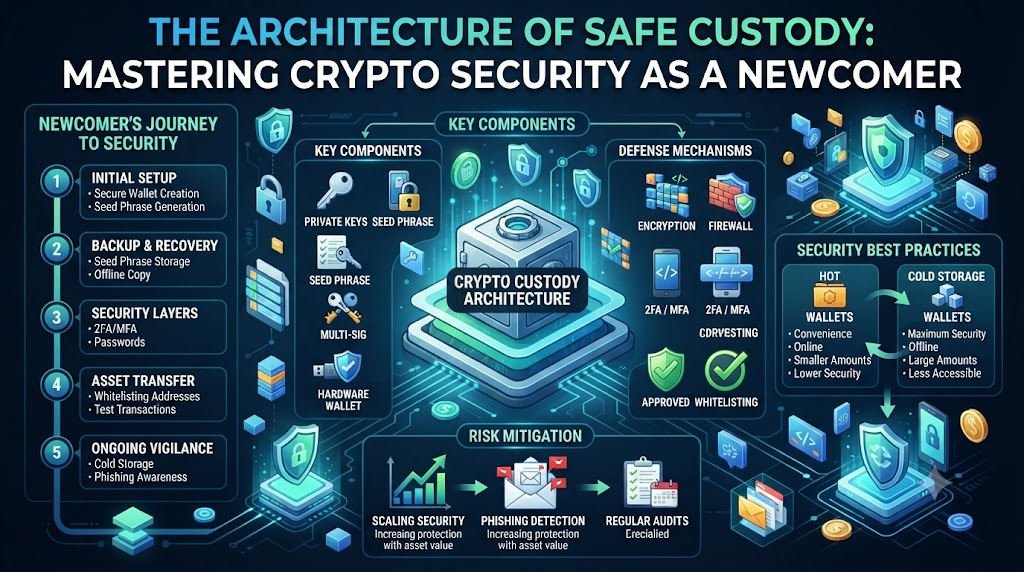
When traditional software systems experience a breach, the root cause is often server-side misconfiguration, corporate credential leakage, or network intrusion. In decentralized networks, the security model operates in reverse. The underlying infrastructure—secured by distributed consensus and immutable cryptographic proofs—rarely fails. Instead, security incidents almost always occur at the edge: the interface where human decisions meet software applications. Approaching crypto security from an analytical, systems-level perspective changes how you protect your assets. Rather than treating safety as a disconnected checklist of rules, understanding the architectural relationships between private keys, consensus engines, and local hardware allows you to identify risks before they materialize. Educational platforms like CryptoBlockCoins focus on dissecting these structural realities so newcomers can navigate digital ownership with technical clarity. This guide analyzes how digital custody functions mechanically, breaks down the core vectors where vulnerabilities emerge, and provides a systematic framework for securing your blockchain assets.
What Is Crypto Security?
From a technical and structural standpoint, crypto security is the discipline of maintaining exclusive, uncompromised control over cryptographic secrets while executing verified state changes across a decentralized ledger. In legacy banking environments, security is relational: your identity verifies your right to instruct a centralized database operator to adjust ledger balances. If unauthorized access occurs, the operator retains administrative power to alter the database state and restore funds. In public blockchain networks, security is mathematical: the network nodes do not know your legal name, physical location, or intent. They evaluate only the validity of cryptographic signatures. Whoever presents the valid mathematical proof commands the asset.
To understand this system, four structural concepts must be clearly defined:
- Public Address: An alphanumeric hash derived from a public key that serves as an open routing identifier for receiving state updates on-chain.
- Private Key: A 256-bit cryptographic secret that generates deterministic digital signatures to validate outbound transactions.
- Seed Phrase (Mnemonic Seed): A standardized 12 to 24-word representation of raw binary entropy that systematically derives an entire hierarchical deterministic tree of private keys.
- Custody Architecture: The operational design that dictates where private keys are generated, stored, and exposed to signing environments.
How Does Crypto Security Work?
Securing asset state transitions on a decentralized ledger relies on asymmetric cryptography coupled with distributed consensus rules.
- Entropy Generation: A wallet uses a random number generator to create high-entropy binary data, which is encoded into a mnemonic seed phrase.
- Deterministic Key Derivation: Using standardized derivation paths, the seed generates master private keys, child private keys, and corresponding public keys.
- Cryptographic Signing: When an outgoing transfer is initiated, the private key signs the transaction payload locally, generating a digital signature using elliptic curve cryptography.
- Gossip Protocol Propagation: The signed payload is broadcast across peer-to-peer network nodes without exposing the underlying private key.
- Consensus Validation: Nodes verify the mathematical proof against the originating public address and check the historical state before appending the transaction into a newly minted block.
+-------------------------------------------------------------------------+
|                        Local Signing Perimeter                          |
|  [Entropy / Seed] ---> [Private Key] ---> [Mathematical Signature]     |
+-------------------------------------------------------------------------+
                                                       |
                                               (Broadcast Signature)
                                                       v
+-------------------------------------------------------------------------+
|                       Consensus Validation Engine                       |
|  1. Node evaluates signature against Public Address via curve math      |
|  2. State change validated against historical distributed ledger        |
|  3. Block finalized and immutably appended to the chain                 |
+-------------------------------------------------------------------------+
Key Components of Crypto Security
Evaluating systemic safety requires analyzing each layer of the technology stack independently.
Cryptographic Key Hierarchy
Public keys are non-sensitive mathematical counterparts to private keys. While public addresses can be indexed across public explorers without security risks, private keys require absolute confidentiality. If an adversary accesses a private key, the system cannot distinguish between the legitimate owner and the attacker.
Wallet Execution Environments
Wallets operate as signing interfaces rather than storage vaults for tokens. The degree of isolation in the execution environment defines the wallet’s security profile:
- Internet-Connected Hot Wallets: Software instances running on standard operating systems. They offer immediate utility for Web3 interactions but remain susceptible to keylogger injection, memory dumping, and browser extension exploits.
- Air-Gapped Cold Storage: Hardware devices that maintain cryptographic isolation by generating keys on secure elements and signing transactions internally, ensuring plaintext keys never traverse host computer memory.
Centralized Exchanges
Centralized trading platforms aggregate liquidity by operating off-chain custodial databases. Users do not interact with the blockchain ledger during internal trades; instead, they trust the exchange’s internal accounting and cold-storage infrastructure. This model trades self-sovereignty for traditional convenience while re-introducing centralized counterparty risk.
Smart Contract Execution Logic
Smart contracts are deterministic programs deployed directly to blockchain virtual machines. While they automate decentralized finance protocols without human intermediaries, structural flaws in the contract code can be systematically drained by automated exploit scripts.
Real-World Case Studies in Security Breakdown
Case 1: The Cloud Backup Exposure
A user creates a non-custodial wallet and writes down the seed phrase. To prevent physical loss, they take a photo of the paper backup. The mobile device automatically uploads the photo to an unencrypted cloud storage backup. Months later, a credential-stuffing attack compromises the cloud account, allowing an attacker to parse the image, derive the private keys, and drain the ledger balance remotely.
Case 2: The Malicious Smart Contract Approval
An active decentralized application user connects their wallet to a fraudulent decentralized finance interface mimicking a legitimate liquidity protocol. When prompted to approve token interaction, the user signs an “unlimited allowance” transaction. This grants the underlying smart contract authorization to transfer all specific tokens from the user’s address without requiring further signatures.
Benefits and Limitations of Cryptographic Ownership
Decentralized architectures trade administrative hand-holding for absolute personal agency.
Benefits
- Zero Administrative Friction: Transactions execute based purely on algorithmic rules without risk of arbitrary institutional cancellation or account closure.
- Deterministic Verification: Anyone can independently verify ledger integrity, transaction confirmations, and balance histories mathematically.
- Unbreakable Cryptographic Defenses: Standard 256-bit private keys cannot be calculated via computational brute force using current computing architectures.
Limitations and Risks
- Permanent Transaction Finality: Ledger immutability means user mistakes, incorrect destination networks, and unauthorized transfers cannot be reversed.
- Zero Systemic Recourse: There is no central identity registry or administrative portal capable of resetting forgotten recovery phrases.
- Asymmetric Attack Advantage: A defender must protect every point of access continuously, whereas an attacker needs only a single compromised signature to drain an account.
Security and Safety Considerations
Mitigating systemic risks requires hardening your operational environment across multiple attack surfaces:
- Eliminate Digital Footprints for Seeds: Never type, store, photograph, or print recovery phrases using internet-connected hardware. Physical stamped metal plates offer superior resilience against fire, water, and digital surveillance.
- Implement Hardware-Backed Authentication: Transition all related account security from SMS-based verification to hardware security tokens or local time-based one-time password (TOTP) generators to eliminate SIM-swap vulnerabilities.
- Segment Operational Risk: Separate assets into dedicated vaults based on utility. Maintain cold-storage devices for long-term reserves and completely separate hot wallets for interactive decentralized finance protocols.
- Regularly Revoke Contract Permissions: Periodically audit and terminate lingering token allowances granted to third-party smart contracts using specialized allowance checkers.
- Validate Cryptographic Details Out-of-Band: Always verify destination addresses, fee rates, and contract parameters on the isolated screen of a hardware device rather than relying on computer monitor outputs.
Common Mistakes Beginners Make
- Exposing Seeds to Digital Environments: Pasting recovery phrases into web forms, password managers, or cloud-synced text files.
- Falling for Social Engineering Vectors: Granting screen access or sharing credentials with individuals claiming to provide technical or community support.
- Blindly Authorizing Unknown Contracts: Signing cryptographic messages or token approvals without understanding what permissions the contract demands.
- Cross-Network Address Confusion: Transferring tokens across incompatible layer-1 or layer-2 networks without configuring proper bridging infrastructure.
- Over-Relying on Custodial Platforms: Leaving significant asset reserves on centralized exchanges rather than establishing personal cold-storage custody.
- Neglecting Clipboard Verification: Failing to confirm every character of a destination address, leaving transactions vulnerable to clipboard-replacing malware.
Custody Architecture Comparison
Choosing the appropriate custody model requires evaluating control structures against operational overhead.
| Architectural Dimension | Non-Custodial Self-Storage | Centralized Exchange Custody |
| Key Generation Point | Generated locally on user hardware | Generated and retained on corporate servers |
| Trust Model | Trust in cryptography and personal process | Trust in corporate solvency and internal controls |
| Recovery Mechanism | Solely dependent on physical seed backups | Identity-based customer support pipeline |
| Attack Vulnerability | Local physical access and phishing vectors | Server breaches, insider threats, and platform freezes |
| Operational Complexity | High personal responsibility required | Low barrier to entry, familiar interface |
Step-by-Step Systematic Hardening Guide
- Acquire Hardware Directly from Source: Purchase dedicated cold-storage hardware directly from the official manufacturer to eliminate supply-chain interception risks.
- Generate Keys in an Air-Gapped Setting: Initialize the wallet offline, verifying that the seed generation process occurs entirely within the device’s secure execution environment.
- Engrave Physical Backups: Stamp the derived mnemonic seed onto fireproof stainless steel or titanium plates, avoiding any electronic recording methods.
- Add Passphrase Protection: Establish a BIP-39 passphrase to create a cryptographically hidden wallet partition for high-value reserve assets.
- Simulate a Full Disaster Recovery: Reset the hardware wallet and successfully restore it using your physical backup before sending any assets to its addresses.
- Execute Incremental Verification Transfers: Always transmit a minimal test transaction to confirm correct address resolution and network functionality before moving larger balances.
Future Considerations
As blockchain engineering progresses, custody systems are advancing toward more resilient, fault-tolerant architectures. Account abstraction is replacing rigid private-key rules with programmable smart contract wallets, enabling features such as daily velocity limits, multi-signature requirements, and social recovery networks that eliminate the single point of failure found in traditional seed phrases.
Furthermore, multi-party computation (MPC) and zero-knowledge cryptographic primitives are redefining how signatures are generated across distributed systems. By splitting signing authority across multiple independent compute environments, these technologies allow users and institutions to achieve institutional-grade protection without compromising usability. As these tools continue to mature, decentralized ownership will become increasingly intuitive while preserving the fundamental principles of trustless security.
Frequently Asked Questions
- Why does crypto security require a different mindset than traditional banking?
Traditional banking relies on centralized administrators who can reverse transactions and reset passwords, whereas blockchain systems operate on immutable mathematical proofs where transactions are permanent and private keys cannot be recovered by third parties.
- What makes private keys computationally secure against brute-force guessing?
Private keys are derived from 256-bit entropy, yielding a search space so astronomically large that current and foreseeable classical computing systems cannot guess a key within realistic timeframes.
- How does malware compromise a crypto wallet on a personal computer?
Malware compromises software wallets by logging keystrokes, capturing screen outputs, reading unencrypted wallet files from memory, or swapping copied destination addresses in the operating system clipboard.
- What is the difference between a mnemonic seed phrase and a private key?
A seed phrase is a human-readable representation of the master entropy that generates an entire hierarchy of private keys and public addresses, whereas a private key controls a single specific public address.
- Why is cold storage superior to hot storage from a technical perspective?
Cold storage isolates the private keys within a secure hardware chip that never exposes the plaintext key to an internet-connected operating system, neutralizing online attack vectors.
- What risks do smart contract approvals introduce to wallet security?
Granting an unlimited token approval allows a smart contract to withdraw specified tokens from your address automatically, meaning a vulnerability or malicious back door in that contract can drain your approved funds.
- How does a SIM-swap attack bypass two-factor authentication?
In a SIM-swap attack, an adversary tricks a mobile carrier into reassigning your phone number to their SIM card, allowing them to intercept SMS verification codes used to access exchange accounts.
- What is a BIP-39 passphrase and how does it enhance security?
A BIP-39 passphrase is an optional custom string added to the seed phrase during key derivation, creating an entirely separate, hidden wallet that protects against physical theft of the recovery phrase.
- Can a hardware wallet be safely used on a computer infected with viruses?
Yes, because private keys never leave the hardware device’s secure element and transactions must be manually confirmed on the device’s physical screen, malware on the host computer cannot extract the keys.
- What is the safest protocol for handling unsolicited airdropped tokens?
The safest protocol is to completely ignore unexpected tokens, as interacting with them often requires signing malicious smart contract transactions engineered to compromise your wallet balance.
Educational Disclaimer
CryptoBlockCoins provides educational information only and does not provide financial or investment advice. Cryptocurrency markets can be volatile, so readers should conduct independent research and consider professional advice before making financial decisions. Understanding the underlying mechanics of crypto security transforms digital asset protection from a stressful guessing game into an exact, disciplined operational process. By recognizing that blockchain safety is defined by cryptographic proofs rather than institutional safety nets, you can systematically eliminate points of failure across your devices, wallets, and signing workflows. Cultivating disciplined habits, isolating your cryptographic keys, and maintaining continuous skepticism toward untrusted interfaces ensures that your journey through decentralized technology remains safe and structurally sound.
Leave a Reply