Strategic AWS Certified DevOps Engineer – Professional Study and Career Planning
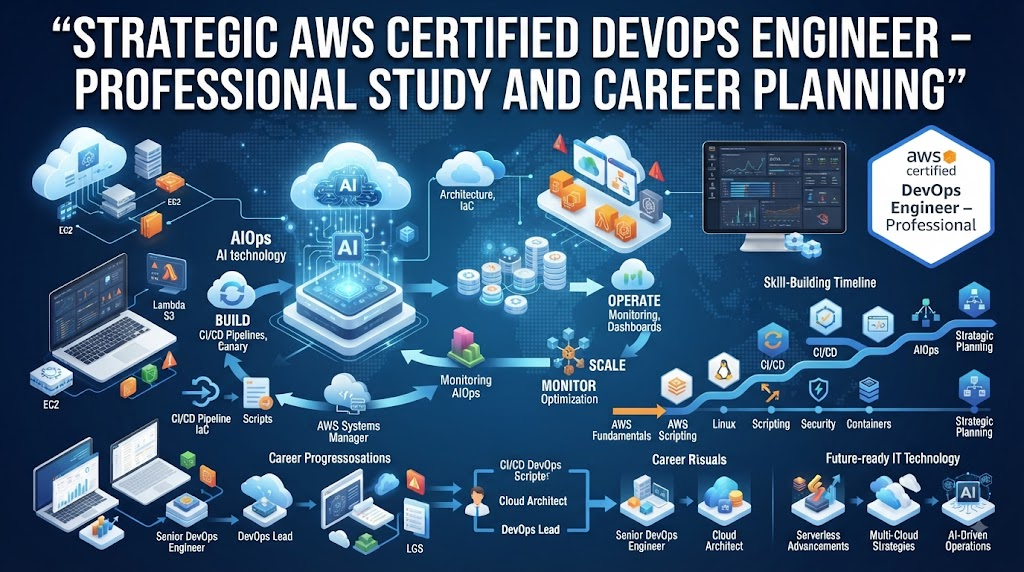
Introduction
Modern businesses expect development teams to release applications quickly while keeping cloud environments stable, secure, and available. This has made DevOps an important part of cloud engineering, particularly for organizations running workloads on AWS. The AWS Certified DevOps Engineer – Professional certification is designed for professionals who already have meaningful AWS and DevOps experience. It focuses on how engineers automate software delivery, manage infrastructure, improve reliability, monitor applications, respond to incidents, and integrate security into operational workflows. This guide explains the certification from a practical perspective, including its exam structure, important AWS technologies, preparation strategy, hands-on projects, and possible career paths.
Understanding AWS Certified DevOps Engineer – Professional
AWS Certified DevOps Engineer – Professional is an advanced certification that validates knowledge of developing and operating automated AWS environments.
The current exam is DOP-C02. Rather than concentrating only on individual AWS services, the certification examines how different services and DevOps practices can be combined to solve real operational problems.
AWS recommends that candidates have two or more years of experience provisioning, operating, and managing AWS environments. This makes the certification more appropriate for experienced cloud and DevOps professionals than for people who are just starting with AWS.
AWS DevOps in Everyday Engineering
AWS DevOps can be viewed as a combination of development practices, operational processes, cloud services, and automation.
A typical workflow might start with a developer committing code and end with an application running in production under continuous monitoring.
Important practices include:
- Continuous integration and delivery
- Automated testing
- Infrastructure as Code
- Deployment automation
- Configuration management
- Monitoring and logging
- Security automation
- Incident response
- Recovery and remediation
The objective is not simply to deploy software faster. A mature DevOps environment should make releases predictable, infrastructure repeatable, systems observable, and failures easier to manage.
Why AWS DevOps Knowledge Is Important
Manual cloud operations can become difficult as applications and infrastructure grow. Automation allows engineering teams to manage repetitive activities consistently.
AWS DevOps practices can help organizations improve:
- Release consistency
- Infrastructure management
- Application reliability
- Operational visibility
- Deployment speed
- Security controls
- Scalability
- Recovery processes
For engineers, this means AWS DevOps knowledge involves more than knowing service names. It requires understanding how cloud infrastructure, applications, security, automation, and operations interact.
DOP-C02 Exam Snapshot
The current AWS certification information includes:
| Exam Feature | Details |
|---|---|
| Certification level | Professional |
| Exam code | DOP-C02 |
| Exam duration | 180 minutes |
| Number of questions | 75 |
| Question formats | Multiple choice and multiple response |
| Standard exam price | USD $300 |
| Certification validity | 3 years |
AWS provides testing-center and online-proctored options. Since AWS can revise certification policies and examination details, candidates should confirm the latest information before registering.
Who Can Benefit From This Certification?
The certification is relevant to professionals in roles such as:
- DevOps Engineer
- AWS Engineer
- Cloud Engineer
- Platform Engineer
- Site Reliability Engineer
- Cloud Architect
- System Administrator
- DevSecOps Engineer
- Cloud Consultant
- AWS Developer
It can also be useful for professionals moving from traditional infrastructure or application development into cloud-focused DevOps roles.
However, the Professional level is much easier to approach when the candidate already has practical AWS experience.
Recommended Background
Before beginning DOP-C02 preparation, it is helpful to have experience with:
- AWS services and architecture
- Linux administration
- Networking
- IAM
- CI/CD concepts
- Infrastructure as Code
- Cloud monitoring
- Security practices
- Automation
- Troubleshooting
AWS’s recommended experience should not be confused with a formal prerequisite for simply registering for the examination. It represents the type of background that can make the exam objectives more manageable.
Current DOP-C02 Exam Domains
The exam currently covers six major areas:
| Domain | Weight |
|---|---|
| SDLC Automation | 22% |
| Configuration Management and IaC | 17% |
| Resilient Cloud Solutions | 15% |
| Monitoring and Logging | 15% |
| Incident and Event Response | 14% |
| Security and Compliance | 17% |
SDLC Automation
This is the largest domain, so candidates should spend considerable time understanding automated software delivery.
Topics include source control, builds, testing, artifacts, pipelines, deployment processes, approvals, release management, and rollback mechanisms.
Configuration Management and Infrastructure as Code
This area focuses on automated infrastructure and configuration management. CloudFormation, AWS CDK, Systems Manager, provisioning, configuration changes, and infrastructure consistency are important subjects.
Resilient Cloud Solutions
This domain examines how to maintain application availability and recover from failures. Study redundancy, failover, replication, backups, recovery, and resilient architecture.
Monitoring and Logging
DevOps engineers need to understand how operational information is collected and interpreted. Important subjects include CloudWatch, CloudTrail, metrics, logs, alarms, dashboards, and tracing.
Incident and Event Response
This area focuses on identifying operational events, investigating problems, responding to failures, and automating remediation where appropriate.
Security and Compliance
Security needs to be integrated into the entire DevOps lifecycle. Candidates should understand IAM, least privilege, encryption, secrets management, security validation, and compliance controls.
For the latest objectives, always consult the official AWS exam guide.
AWS Services Worth Studying
Rather than memorizing a huge list of services, organize your preparation around DevOps tasks.
Compute: EC2, Lambda, Auto Scaling
Containers: ECS, EKS, ECR
Storage: S3
Databases: RDS, DynamoDB
Networking: VPC, Route 53, Elastic Load Balancing, CloudFront
CI/CD: CodePipeline, CodeBuild, CodeDeploy
Infrastructure: CloudFormation and AWS CDK
Operations: Systems Manager
Monitoring: CloudWatch, CloudTrail, X-Ray
Security: IAM, KMS, Secrets Manager, AWS Config
The important part is understanding how these services can work together.
Building an AWS CI/CD Pipeline
A simple AWS delivery process can be represented as:
Source → Build → Test → Artifact → Deploy → Monitor → Recover
A developer commits code to a repository. The pipeline starts a build and automated tests. If validation succeeds, the resulting artifact can move into the deployment stage.
The application might then be released using a rolling, blue-green, or canary approach. Monitoring tools evaluate the application’s health after deployment.
If the release creates unexpected behavior, alerts can notify engineers and automated mechanisms can support rollback or remediation.
This end-to-end understanding is more useful than memorizing isolated service definitions.
Infrastructure as Code and Automation
Infrastructure as Code allows cloud resources to be described and managed through templates or code.
AWS CloudFormation can define infrastructure in reusable templates. Engineers can store those templates in version control, review changes, and deploy consistent environments.
AWS CDK provides another approach by allowing infrastructure to be defined using supported programming languages.
AWS Systems Manager can assist with operational activities such as configuration management, patching, automation, and system administration.
These tools reduce dependency on manual configuration and make infrastructure changes easier to reproduce.
Monitoring and Observability
A production DevOps environment needs reliable visibility.
Monitoring may include:
- Infrastructure metrics
- Application metrics
- Logs
- Alerts
- Dashboards
- Traces
- Events
For example, if application error rates suddenly increase, a CloudWatch alarm can notify the operations team. Engineers can then compare logs, metrics, recent deployments, and infrastructure changes to identify the likely cause.
Good observability is not simply about collecting data. The information should help engineers make faster and more accurate operational decisions.
Security in AWS DevOps
Security should be considered throughout the delivery lifecycle rather than added after deployment.
Important areas include:
- Least-privilege IAM
- Encryption
- Secrets management
- Secure pipelines
- Vulnerability detection
- Policy enforcement
- Audit logging
- Compliance controls
A DevOps engineer should understand how security requirements affect infrastructure, deployment processes, permissions, and application operations.
Deployment Strategies
Different applications require different deployment approaches.
Rolling deployment: Updates resources gradually rather than changing everything simultaneously.
Blue-green deployment: Maintains separate environments and shifts traffic from the existing version to the new version.
Canary deployment: Releases a new version to a small percentage of users before expanding it.
Immutable deployment: Creates replacement infrastructure instead of modifying the existing environment.
Automated rollback: Reverts a release when health checks or defined conditions indicate a problem.
The correct choice depends on factors such as availability requirements, application architecture, risk, cost, and recovery expectations.
A Realistic AWS DevOps Workflow
Consider a team releasing a new application version.
The developer pushes code to source control. An automated pipeline starts the build and test process. Once the tests pass, an artifact is prepared for deployment.
Infrastructure changes are managed through Infrastructure as Code. The application is then deployed using an appropriate release strategy.
After deployment, monitoring tools watch application performance and infrastructure health.
Suppose the new version causes a sudden increase in errors. An alarm notifies the team. Engineers review logs and metrics, compare the issue with recent changes, and decide whether to repair the release or roll it back.
Once the problem is resolved, the team can improve testing, monitoring, or deployment automation to reduce the chance of recurrence.
Hands-on Projects for Preparation
Practical projects can turn abstract concepts into usable skills.
Good projects include:
- Build a complete AWS CI/CD pipeline.
- Deploy infrastructure using CloudFormation.
- Create a containerized application deployment.
- Build CloudWatch dashboards and alarms.
- Configure automated rollback.
- Add security controls to a deployment pipeline.
- Create automated incident remediation.
A useful technique is to intentionally introduce failures into your projects and practice finding the cause.
A Practical Preparation Roadmap
A structured approach can make preparation more manageable.
Step 1: Check Your Fundamentals
Review AWS architecture, networking, IAM, Linux, and DevOps basics.
Step 2: Study the Official Exam Guide
Understand the current domains and their relative weight.
Step 3: Learn Service Integration
Study how AWS services work together instead of treating every service as a separate topic.
Step 4: Practice Hands-On
Build pipelines, infrastructure, monitoring systems, and deployment workflows.
Step 5: Work on Troubleshooting
Practice analyzing failures involving permissions, deployments, networking, configuration, and application health.
Step 6: Take Practice Assessments
Use practice questions to identify areas where your understanding needs improvement.
Step 7: Review Weak Topics
Return to official documentation and hands-on labs for difficult subjects.
Step 8: Verify Current Exam Information
Check AWS’s latest exam page before scheduling your test.
AWS Skill Builder can also be used as part of a broader AWS learning plan.
Common Preparation Mistakes
Some preparation habits can make the process less effective.
Avoid:
- Memorizing question banks.
- Skipping hands-on labs.
- Learning services without understanding their relationships.
- Ignoring troubleshooting.
- Treating security as a minor topic.
- Using outdated exam material.
- Depending on practice questions without reviewing why answers are correct.
Professional-level preparation should focus on technical reasoning and practical decision-making.
Career Opportunities
AWS DevOps knowledge can support several career paths, including:
- AWS DevOps Engineer
- Cloud Engineer
- Platform Engineer
- Site Reliability Engineer
- DevSecOps Engineer
- Cloud Architect
- Cloud Consultant
The certification can strengthen a professional profile, but it does not guarantee a particular job, promotion, or salary. Practical experience and problem-solving skills remain important.
Related AWS Certifications
| Certification | Main Focus | Level | Suitable For |
|---|---|---|---|
| AWS DevOps Engineer – Professional | DevOps and automation | Professional | Experienced DevOps professionals |
| AWS Solutions Architect – Professional | Cloud architecture | Professional | Experienced architects |
| AWS Developer – Associate | Application development | Associate | Developers |
| AWS SysOps Administrator – Associate | AWS operations | Associate | Operations professionals |
The appropriate certification depends on your current skills and desired career direction.
Where AWS DevOps Is Heading
AWS DevOps continues to evolve as organizations adopt new engineering practices.
Important areas include:
- AI-assisted development and operations
- Platform Engineering
- DevSecOps
- GitOps
- Kubernetes
- Serverless architecture
- Automated remediation
- Infrastructure automation
- Advanced observability
The role of the DevOps engineer is gradually moving toward building reliable automation, internal platforms, and repeatable engineering processes.
FAQs
1. What is AWS Certified DevOps Engineer – Professional?
It is an advanced AWS certification focused on DevOps automation, software delivery, infrastructure management, monitoring, security, resilience, and incident response.
2. Who should take the AWS DevOps Professional exam?
It is mainly suitable for experienced AWS, DevOps, cloud, operations, SRE, and platform professionals.
3. Is DOP-C02 difficult?
It can be challenging because it tests professional-level AWS and DevOps scenarios. Practical experience can make the concepts easier to understand.
4. Is AWS experience required?
AWS recommends two or more years of relevant experience, although recommended experience and formal exam eligibility are not necessarily the same thing.
5. How many questions are in DOP-C02?
The current exam contains 75 questions.
6. How long is the AWS DevOps Professional exam?
Candidates receive 180 minutes to complete the exam.
7. Which topics should I prioritize?
Focus on SDLC automation, Infrastructure as Code, resilience, monitoring, incident response, and security.
8. Do hands-on AWS projects help?
Yes. Building pipelines, infrastructure, monitoring systems, and deployment workflows can improve practical understanding.
9. How long is AWS DevOps Professional certification valid?
AWS certifications are generally valid for three years.
10. What can I learn after this certification?
Depending on your career goals, you can explore cloud architecture, DevSecOps, SRE, Kubernetes, Platform Engineering, security, or observability.
Conclusion
The AWS Certified DevOps Engineer – Professional certification provides an opportunity for experienced cloud professionals to validate their knowledge of advanced AWS DevOps practices. Its scope covers much more than deployment pipelines, extending into infrastructure automation, resilient architecture, observability, security, incident response, and operational improvement. A productive preparation strategy combines the current AWS exam guide with hands-on projects, troubleshooting exercises, official documentation, and scenario-based practice. Instead of relying on memorization, candidates should focus on understanding why a particular AWS solution is appropriate for a given technical situation. For long-term career development, the certification can be combined with practical experience and complementary skills in areas such as cloud architecture, SRE, DevSecOps, Kubernetes, Platform Engineering, and observability.
Leave a Reply