Scaling Engineering Teams: A Step-by-Step Guide to Hire a DevOps Freelancer
Introduction
Software delivery stalls when infrastructure management bottlenecks software developers. Engineering managers and startup founders often find their developers spending more time debugging broken staging environments, managing AWS access keys, and running manual deployments than writing product features. When releases become risky and infrastructure costs surge, engineering teams realize they need dedicated operational maturity. Hiring a full-time, in-house DevOps engineer takes months, requires substantial budget commitments, and is not always justified for specific project milestones. For many growing organizations, the practical answer is to hire a DevOps freelancer who can step in, automate critical delivery paths, stabilize cloud infrastructure, and establish modern engineering workflows. Organizations seeking targeted expertise can explore platforms like DevOpsFreelancer.com to find experienced cloud engineers for project-based initiatives. This guide outlines how to evaluate your operational requirements, identify the right technical competencies, avoid common hiring mistakes, and seamlessly integrate a freelance specialist into your development lifecycle.
Main Article
Understanding the Role of Modern DevOps in Growing Teams
DevOps is frequently misunderstood as a tooling suite rather than an operational discipline. It represents the union of development practices, operational oversight, and automated tooling designed to shorten the systems development life cycle while delivering features, fixes, and updates reliably.
In smaller or mid-sized engineering teams, developers often inherit operational duties out of necessity. They deploy code directly from local terminals, adjust cloud console settings manually, and handle server outages reactively. This approach works in early prototyping phases, but it quickly accumulates technical debt.
When infrastructure changes are undocumented, environments drift apart. A configuration that works in development fails in production. Manual server updates leave security vulnerabilities unpatched, and deployments require late-night engineering shifts to resolve unforeseen service breaks. A seasoned freelance DevOps engineer addresses these operational risks by establishing programmatic, repeatable infrastructure that allows software teams to ship code with confidence.
What Does a Freelance DevOps Engineer Do?
A freelance DevOps specialist provides tactical engineering bandwidth or strategic architectural guidance. Their responsibilities span several functional pillars:
- CI/CD Pipeline Design: Building automated pipelines using platforms like GitHub Actions, GitLab CI/CD, or Jenkins to test, package, and deploy applications automatically whenever code is merged.
- Infrastructure as Code (IaC): Replacing manual cloud dashboard clicks with declarative code using Terraform or AWS CloudFormation, ensuring cloud assets are version-controlled, auditable, and easily reproducible.
- Containerization and Orchestration: Packaging applications into Docker containers and orchestrating them via Kubernetes, Amazon EKS, or Azure AKS for reliable resource scaling and application isolation.
- Cloud Architecture and Cost Management: Structuring cloud networks, computing resources, and storage across AWS, Azure, or Google Cloud Platform (GCP) while eliminating idle or over-provisioned infrastructure.
- Observability and Monitoring: Setting up centralized logging, telemetry, and metrics dashboards using Prometheus, Grafana, or native cloud tools like Amazon CloudWatch to detect regressions before end-users notice them.
- Security and Compliance: Embedding automated vulnerability scanning, access management controls, and encrypted secrets storage into delivery pipelines.
Business Triggers: When Should You Hire a DevOps Freelancer?
Not every infrastructure issue requires an immediate full-time hire. A contract specialist is particularly valuable during specific inflection points in an organization’s growth.
+-----------------------------------------------------------------------------------+
|                              TYPICAL ADOPTION PATH                                |
|                                                                                   |
|  [Early-Stage Project] ---> [Rapid Product Growth] ---> [Matured Systems]         |
|  Manual Deployments          CI/CD Automation            Platform Engineering     |
|  Direct Cloud Console       Terraform / Kubernetes       Dedicated SRE Teams      |
|                                                                                   |
|                       ^                                                           |
|                       |--- HIRE A DEVOPS FREELANCER HERE                          |
+-----------------------------------------------------------------------------------+
1. Migrating from Monolith to Microservices or Containers
When moving applications from legacy virtual machines to containerized environments, engineering teams often lack deep container networking and orchestration knowledge. A Kubernetes Freelancer can design clusters, configure ingress controllers, and set up pod autoscaling without taking core product developers away from their roadmap.
2. High Cloud Infrastructure Inefficiencies
Unmonitored cloud spending is a common side effect of rapid product prototyping. Development teams spin up instances, provision oversized databases, and forget unattached block storage volumes. A specialist evaluates resource usage, implements auto-scaling policies, and optimizes storage tiers to control recurring monthly cloud bills.
3. Fragile, Manual Deployment Processes
If deploying a new release requires runbooks with dozens of manual steps, production releases become stressful and infrequent. A freelance engineer builds repeatable pipelines that run automated unit tests, build container images, run database migrations, and perform blue-green or canary deployments with automated rollback triggers.
4. Preparation for Security and Compliance Audits
Preparing for SOC 2, ISO 27001, or HIPAA compliance requires strict access controls, auditable change logs, and encrypted data at rest and in transit. A DevSecOps Freelancer audits existing systems, removes hardcoded secrets, introduces identity-based access, and sets up continuous security scans.
Technical Specializations: Choosing the Right Focus
The DevOps umbrella is broad. When preparing to hire, defining the specific technical domain ensures you find a professional equipped for your specific environment.
AWS DevOps Freelancers
An AWS DevOps Freelancer concentrates on the Amazon Web Services ecosystem. They navigate AWS Identity and Access Management (IAM) to enforce least-privilege permissions, provision compute via EC2, ECS, or EKS, and build reliable networking environments using Amazon VPCs, Transit Gateways, and Route 53. They automate deployments with AWS CodePipeline or external continuous integration systems connected via OpenID Connect (OIDC).
Terraform and IaC Specialists
A Terraform Freelancer standardizes infrastructure provisioning across providers. Instead of treating servers like individual systems requiring manual maintenance, they write declarative configuration files. They structure reusable Terraform modules, manage remote state locking through Amazon S3 and DynamoDB or Terraform Cloud, and prevent configuration drift across staging and production environments.
Kubernetes and Orchestration Specialists
Managing containerized workloads at scale requires nuanced operational knowledge. A specialist sets up Amazon EKS or Azure AKS, writes declarative Helm charts or Kustomize manifests, implements service meshes if necessary, and configures cluster autoscaling. They also troubleshoot networking latency, ingress rules, and pod scheduling constraints.
Azure DevOps Specialists
An Azure DevOps Freelancer is suited for organizations embedded within Microsoft enterprise environments. They manage Azure Pipelines, configure hybrid cloud connections, manage Azure Active Directory (Entra ID) integrations, and deploy workloads to Azure App Services or Azure Kubernetes Service (AKS).
Reliability and Observability (SRE)
An SRE Freelancer (Site Reliability Engineer) focuses on production resilience. They establish Service Level Indicators (SLIs) and Service Level Objectives (SLOs), configure error budgets, design automated self-healing mechanisms, and build telemetry monitoring pipelines using Prometheus, Grafana, or OpenTelemetry to minimize mean time to recovery (MTTR).
Comparing Infrastructure Delivery Models
Choosing between an agency, an in-house full-time hire, or a freelance professional depends directly on project scope, timeline, and available budget.
| Consideration Factor | Full-Time Employee | Traditional Agency | DevOps Freelancer |
|---|---|---|---|
| Hiring Timeline | 6 to 12 weeks | 1 to 3 weeks | 3 to 10 days |
| Cost Structure | High fixed overhead (salary + benefits) | High hourly or retainer rates | Flexible project-based or hourly rates |
| Commitment Level | Long-term organizational asset | Multi-month contract minimums | Variable (days, weeks, or months) |
| Direct Communication | Direct daily integration | Handled through project managers | Direct collaboration with engineers |
| Best Used For | Continuous operational ownership | Large enterprise transformation | Targeted projects, modernization, burst capacity |
Key Technical Competencies to Evaluate
Evaluating a freelance engineer requires testing applied problem-solving abilities rather than theoretical knowledge. Prioritize candidates who demonstrate depth in these foundational areas:
1. Declarative Infrastructure Automation
Look for experience writing modular, dry (Don’t Repeat Yourself) Infrastructure as Code. The candidate should be able to explain how they handle sensitive state files, manage dependencies between cloud resources, and test configurations before applying changes to live environments.
2. Linux and Systems Fundamentals
Regardless of cloud provider abstractions, containers run on Linux. A qualified engineer must understand system signals, process isolation, memory management, kernel parameters, storage volumes, and basic shell scripting (Bash).
3. Practical Networking Concepts
Cloud engineering relies heavily on proper networking fundamentals. Candidates should be comfortable setting up subnets, configuring Network Address Translation (NAT) gateways, managing DNS records, setting up reverse proxies, handling SSL/TLS certificate termination, and isolating private workloads from public internet exposure.
4. Production Security Practices
Avoid candidates who treat security as an afterthought. Ask how they secure production pipelines without hardcoding static credentials. They should demonstrate familiarity with secret management vaults, temporary role assumption, network access policies, and automated vulnerability scanning for base container images.
Step-by-Step Vetting and Interview Framework
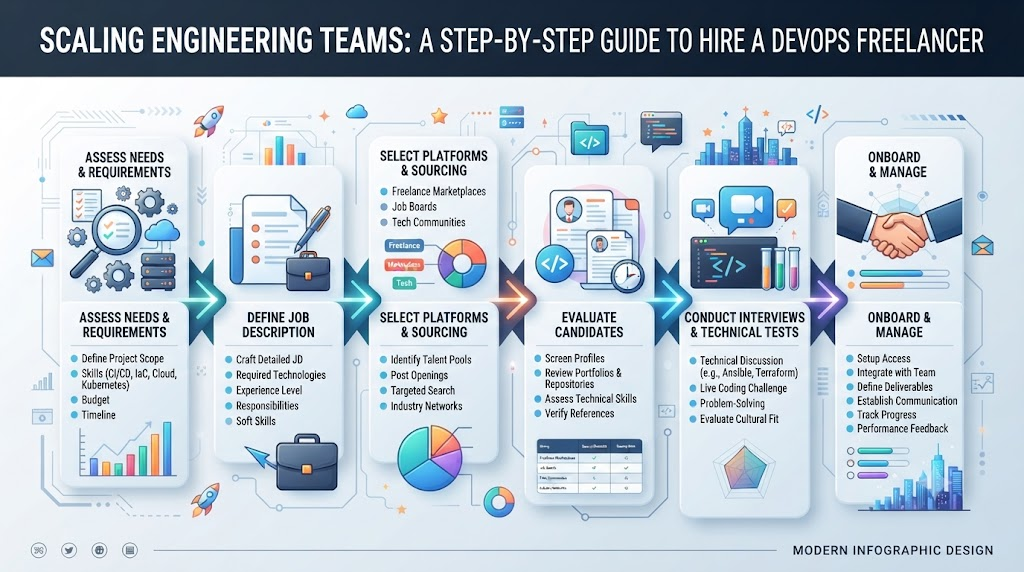
To accurately assess a freelance engineer’s capabilities without introducing unnecessarily prolonged interview cycles, apply a structured three-phase evaluation process:
[Phase 1: Architecture Review] ---> [Phase 2: Scenario Problem-Solving] ---> [Phase 3: Trial Task]
Review past design work             Troubleshoot live production failure      Scoped, paid, non-critical project
Phase 1: Architectural Review
Begin by discussing an architecture they built in a past role. Ask them to diagram or describe the network topology, how deployments reached production, where secrets were stored, and how the system handled database failovers. Pay close attention to whether they understand why specific architectural choices were made over alternatives.
Phase 2: Scenario-Based Troubleshooting
Present a realistic production failure rather than an abstract whiteboard coding algorithm. For example:
“A newly deployed containerized service is failing health checks and causing crash loops in the cluster. How would you systematically diagnose whether the issue is related to application code, environment variable misconfigurations, resource starvation, or network access limitations?”
An experienced engineer will outline a structured triage process: inspecting container logs, describing pod lifecycle states, verifying DNS and database connectivity, checking resource limits, and inspecting recent pipeline commits.
Phase 3: Small, Paid Discovery or Pilot Project
Before granting widespread access to primary production clusters, hire the professional for a small, clearly defined initial task. Useful trial projects include:
- Migrating a secondary staging service to a new CI/CD workflow.
- Writing a Terraform module for a new internal service.
- Performing a security and cloud cost audit of existing environments.
This exposes their communication speed, documentation habits, code quality, and delivery reliability with minimal operational risk.
Integrating a DevOps Freelancer Securely
A major concern for engineering managers when hiring external specialists is security and access control. Never compromise infrastructure safety for speed.
Principle of Least Privilege (PoLP)
Never grant a freelancer broad administrative access to your cloud organization. Create role-based IAM policies scoped only to the specific resources, repositories, and clusters they need to modify.
Ephemeral Access and Audit Logging
Use centralized identity providers with mandatory Multi-Factor Authentication (MFA). Enable detailed audit logs using AWS CloudTrail, Azure Activity Log, or GCP Cloud Audit Logs to track every infrastructure change. Ensure access keys expire automatically and rotate regularly.
Safe Separation of Production Environments
Whenever possible, have the specialist build, test, and validate configurations in a dedicated development or sandbox account. Only promote changes to production after review by an internal technical lead through a formal pull request process.
Offboarding Protocols
At the conclusion of the contract, maintain an offboarding checklist:
- Deprovision IAM accounts and access tokens.
- Revoke SSH access keys and Git repository permissions.
- Rotate any shared secrets or service credentials touched during the engagement.
- Confirm that all operational documentation and code repositories are pushed to internal company repositories.
Practical Tips / Key Takeaways
- Define Deliverables Over Broad Titles: Avoid hiring for vague objectives like “make our cloud better.” Specify explicit outcomes: “automate our staging deployment with GitHub Actions and Terraform.”
- Prioritize Documentation: Mandate that all infrastructure code is thoroughly documented. If your internal team cannot understand or modify the systems after the freelancer leaves, the project creates ongoing technical debt.
- Treat Infrastructure as Software: All cloud changes should live in version-controlled repositories and go through code reviews, automated linting, and staging runs before production application.
- Evaluate Regional Talent Pools: Sourcing talent through specialized channels, such as engaging a DevOps Freelancer India, allows companies to access experienced cloud engineering expertise across complementary time zones for continuous operational support.
- Review Production Experience Over Paper Certifications: Cloud provider certifications prove that a candidate studied the documentation, but production debugging experience proves they know how to recover broken systems under pressure.
10 FAQs
What is the primary benefit when I hire a DevOps freelancer?
Hiring a freelancer gives you rapid access to specialized infrastructure skills without the long recruitment cycles, benefits, and long-term overhead of a full-time hire. They solve targeted problems like pipeline automation, cloud cost reduction, or container orchestration quickly.
How do I ensure our company’s cloud infrastructure remains secure?
Enforce the principle of least privilege, require multi-factor authentication, and avoid sharing administrative root accounts. Grant scoped access via temporary roles, enable audit logging, and require all infrastructure updates to be submitted as reviewed pull requests.
What is the difference between a DevOps engineer and a Cloud Architect?
A Cloud Architect focuses primarily on high-level system design, service selection, networking architecture, and compliance frameworks. A DevOps engineer focuses on the hands-on implementation, automating cloud resources through code, building CI/CD pipelines, and maintaining operational reliability.
When should a business choose a Kubernetes freelancer?
Engage a Kubernetes specialist when your development team is migrating from monolithic virtual machines to microservices, struggling with container scaling, experiencing networking bottlenecks, or spending excessive time manually managing application updates and rollbacks.
Why is Infrastructure as Code (IaC) critical when using freelancers?
Infrastructure as Code ensures that everything the external professional builds is auditable, repeatable, and version-controlled. If configurations are written in Terraform or CloudFormation, your internal engineering team can easily understand, manage, and recreate the setup later.
Can a freelance DevOps engineer help reduce cloud hosting costs?
Yes. Specialists review your resource utilization, identify unattached disks and idle compute instances, set up automated resource scheduling for staging environments, implement rightsizing recommendations, and structure reserved capacity to lower monthly cloud expenditures.
What does a DevSecOps freelancer focus on?
A DevSecOps engineer integrates automated security checks directly into your development workflow. They configure static application analysis, container image scanning, dynamic vulnerability checks, and automated secrets management, ensuring compliance without slowing down delivery velocity.
How long does a typical freelance DevOps engagement last?
Engagements vary based on project scope. A targeted CI/CD setup or infrastructure audit might take two to four weeks. Complex cloud migrations or Kubernetes implementations often run between two and six months on a part-time or milestone basis.
What should I prepare before hiring a DevOps freelancer?
Prepare an overview of your current technology stack, architectural diagrams, repository structures, and a clear list of operational pain points. Defining specific goals and access constraints upfront ensures the specialist starts effectively from day one.
Where can businesses find vetted DevOps contract professionals?
Engineering teams can tap into established professional networks, developer communities, and specialized platforms such as DevOpsFreelancer.com to find experienced cloud engineers with proven track records in automation, containers, and cloud architecture.
Conclusion
Modern software organizations cannot afford brittle release cycles, manual configuration errors, and unmanaged cloud environments. While building an internal platform engineering team is a valuable long-term goal, bringing in targeted external expertise allows you to resolve immediate operational bottlenecks without delay. When you hire a DevOps freelancer with demonstrated production experience, clear communication habits, and a commitment to automation, your business gains more than temporary support. You establish stable, reproducible infrastructure that empowers your internal software developers to release features faster and with greater confidence. Evaluate your current operational gaps, establish structured vetting criteria, and leverage specialized freelance talent to build resilient systems designed for growth.
Leave a Reply