Optimizing Distributed Systems via Modern Cloud Operations Frameworks
Introduction
When distributed systems scale rapidly, internal engineering teams frequently encounter severe operational friction trying to maintain stability without sacrificing release velocity. Legacy administrative models typically fail under dynamic workloads, resulting in painful troubleshooting bottlenecks and unexpected production outages. Adopting disciplined cloud operations enables technical organizations to replace fragile manual routines with predictable, code-driven workflows. This guide examines the fundamental architecture, operational patterns, and engineering strategies necessary to build high-availability environments. Read on to discover how modern operational frameworks transform everyday infrastructure management.
2. What Is Cloud Operations?
Cloud operations involves the continuous orchestration, administration, maintenance, and automated optimization of workloads deployed across distributed cloud environments. Its core objective is ensuring that infrastructure remains highly reliable, secure, performant, and cost-efficient throughout its lifecycle. Serving as the vital bridge between software development and infrastructure stability, this discipline ensures smooth artifact delivery while maintaining underlying system health. Engineering teams utilize these practices to eliminate repetitive manual toil and establish repeatable execution patterns. Organizations seeking to minimize human error and maximize uptime rely heavily on these structured methodologies.
3. How Does Cloud Operations Work?
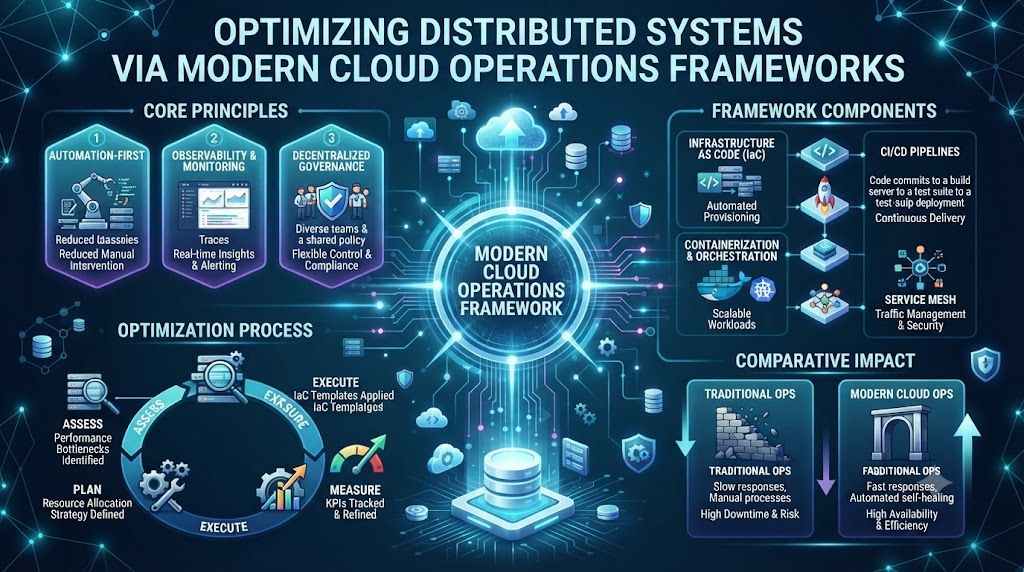
The underlying machinery of efficient infrastructure management follows a continuous lifecycle of definition, deployment, observation, and automated remediation.
- Declarative Provisioning: Engineers translate infrastructure requirements into version-controlled configuration templates.
- Configuration Synchronization: Automated tools apply uniform software and security baselines across all target nodes.
- Pipeline Promotion: Automated release pipelines safely validate, test, and push application artifacts into production environments.
- Telemetry Collection: Lightweight agents gather real-time performance metrics, system logs, and distributed traces from all running services.
- Observability Analysis: Centralized analytics platforms process incoming telemetry streams to surface anomalies before users are impacted.
- Self-Healing Execution: Automated remediation scripts trigger corrective workflows instantly when defined operational thresholds are breached.
4. Core Components of Cloud Operations
Infrastructure as Code
Infrastructure as Code allows teams to manage and provision computing resources through version-controlled definition files rather than manual console interactions. This practice completely eliminates configuration drift and guarantees absolute parity across development, staging, and production tiers.
Cloud Automation
Automation engines execute routine administrative tasks, security patching, backup cycles, and scaling events without manual touchpoints. Removing human intervention from repetitive execution workflows drastically reduces mean time to resolution and prevents operator oversight.
Monitoring and Observability
Comprehensive telemetry aggregation grants deep visibility into resource saturation and application health. Correlating multi-dimensional metrics, system logs, and distributed traces enables engineers to isolate complex microservice failures rapidly.
5. Role of AWS, Azure, and GCP
Operating across modern hyper-scale clouds requires balancing native provider tooling with portable architectures. Amazon Web Services (AWS), Microsoft Azure, and Google Cloud Platform (GCP) provide specialized management planes that influence daily administrative routines.
| Feature | Amazon Web Services (AWS) | Microsoft Azure | Google Cloud Platform (GCP) |
| Infrastructure as Code | AWS CloudFormation / CDK | Azure Resource Manager (ARM) / Bicep | Google Cloud Deployment Manager / Terraform |
| Container Orchestration | Amazon ECS & Amazon EKS | Azure Kubernetes Service (AKS) | Google Kubernetes Engine (GKE) |
| Telemetry & Logging | Amazon CloudWatch & X-Ray | Azure Monitor & Application Insights | Cloud Logging & Cloud Monitoring |
6. Cloud Operations and Automation Considerations
Modern infrastructure management treats infrastructure identically to application source code. Utilizing declarative tools like Terraform alongside container orchestrators like Kubernetes ensures that resource scaling and deployment lifecycles remain completely deterministic. Automated policy checks block non-compliant configurations before they reach production, maintaining strict governance standards without slowing down development velocity.
7. Monitoring, Observability, and Reliability
Maintaining resilient cloud systems requires shifting from reactive firefighting to proactive observability. Teams must establish meaningful Service Level Indicators (SLIs) and Service Level Objectives (SLOs) tied directly to end-user experience metrics. Implementing disciplined error budgets ensures a healthy balance between rapid feature delivery and robust system stability.
8. Security and Governance
Security in cloud-native ecosystems must be embedded directly into operational workflows rather than treated as an afterthought. Enforcing strict least-privilege models across identity and access management (IAM) policies limits potential blast radiuses during security events. Continuous compliance validation, automated secrets management, and encrypted data channels safeguard enterprise workloads.
9. Best Practices
- Codify All Infrastructure: Manage every networking, compute, and storage resource using version-controlled code templates to prevent configuration drift.
- Implement Least Privilege Access: Restrict user and service account permissions strictly to the operational minimum required for active tasks.
- Establish Unified Observability: Centralize metrics, logs, and distributed traces into unified tools to accelerate cross-team incident root-cause analysis.
- Automate Failure Recovery: Design self-healing pipelines and automated failover routines to minimize human intervention during production outages.
- Enforce Resource Tagging Standards: Implement mandatory tagging policies to track ownership, environments, and cost allocation accurately.
- Run Regular Chaos Engineering: Test system resilience proactively by injecting controlled failures into non-production and staging environments.
10. Common Mistakes
- Relying on manual console adjustments rather than automated code templates for production resource provisioning.
- Collecting massive volumes of raw logs without actionable alert rules, resulting in severe operational alert fatigue.
- Neglecting comprehensive disaster recovery drills until an actual catastrophic production failure occurs.
- Granting overly permissive access roles to developer accounts to bypass short-term workflow friction.
- Failing to monitor cloud spending trends proactively, leading to unexpected invoice spikes.
11. Real-World Use Cases
- High-Traffic E-Commerce Platforms: Utilizing automated horizontal pod autoscaling and multi-region load balancing to handle traffic surges smoothly during seasonal sales events.
- Fintech Multi-Cloud Deployments: Distributing critical database workloads across multiple cloud providers to maintain business continuity and strict regulatory compliance.
- Microservices Application Monitoring: Deploying distributed tracing and centralized log aggregation to isolate performance degradation across interconnected containerized services.
12. Challenges and Limitations
Adopting advanced infrastructure workflows brings notable hurdles, such as steep engineering learning curves and significant tool sprawl. Managing disparate automation scripts and maintaining secure multi-vendor permissions can increase operational overhead if governance frameworks are poorly defined. Furthermore, excessive reliance on automated remediation can sometimes mask deeper, systemic application architectural flaws.
13. Step-by-Step Implementation Guide
- Assess Current Capabilities: Evaluate existing infrastructure deployment patterns, manual bottlenecks, and monitoring gaps across teams.
- Define Operational Policies: Establish naming conventions, tagging standards, and core security guardrails for all cloud environments.
- Adopt Infrastructure as Code: Migrate manual server configurations into version-controlled Terraform or native cloud template modules.
- Deploy Telemetry Agents: Instrument applications and infrastructure nodes with unified monitoring tools and log forwarders.
- Establish CI/CD Pipelines: Build automated testing, security scanning, and deployment pipelines to streamline software releases.
- Review and Optimize: Conduct regular post-incident reviews and cost audits to drive continuous operational improvement.
14. Future of Cloud Operations
The evolution of infrastructure management points strongly toward AI-assisted diagnostics, autonomous self-healing networks, and advanced platform engineering models. As systems scale in complexity, machine learning models will assist engineers by predicting capacity bottlenecks and resolving routine operational anomalies automatically. Embracing these emerging paradigms allows modern organizations to maintain resilient, future-proof cloud architectures.
Frequently Asked Questions
- What is the primary goal of cloud operations?
The main objective is to guarantee the continuous reliability, security, scalability, and cost efficiency of applications and infrastructure hosted in cloud environments.
- How does cloud operations differ from traditional IT operations?
Traditional IT focuses heavily on physical hardware maintenance and manual rack-and-stack tasks, whereas cloud operations leverages software engineering principles, APIs, and automation.
- Why is Infrastructure as Code essential for cloud operations management?
Infrastructure as Code ensures complete environment consistency, eliminates manual human configuration errors, and allows teams to version-control their infrastructure modifications.
- What role does cloud monitoring play in system reliability?
Cloud monitoring provides real-time visibility into CPU utilization, network throughput, and application health, enabling teams to detect anomalies before users experience downtime.
- How do AWS, Azure, and GCP impact multi cloud management?
Major cloud providers offer distinct proprietary APIs and native management services, requiring teams to use abstraction layers or unified tools to maintain consistent workflows.
- What are the key benefits of implementing cloud automation?
Automation reduces manual toil, accelerates software delivery velocity, minimizes human configuration errors, and ensures predictable, repeatable infrastructure deployments.
- How can engineering teams improve security within cloud infrastructure management?
Teams can enhance security by enforcing strict least-privilege access policies, utilizing automated vulnerability scanners, and managing secrets securely through dedicated vaults.
- What is the difference between monitoring and observability?
Monitoring tells you when a system is broken by tracking predefined metrics, whereas observability allows you to understand why it broke by inspecting deep telemetry data.
- How do cloud operations best practices help control cloud spending?
Best practices include continuous resource right-sizing, automated shutdown of idle staging instances, and rigorous cost allocation tagging across all environments.
- What skills are required to build a career in cloud operations?
Professionals need a strong grasp of networking principles, Linux administration, containerization technologies, scripting languages, and modern automation frameworks.
Conclusion
Mastering cloud operations is essential for building scalable, resilient, and secure digital architectures in modern technological landscapes. By replacing manual interventions with robust automation, disciplined monitoring, and Infrastructure as Code, engineering teams can significantly reduce operational overhead and downtime. Implementing these structured practices ensures long-term system stability and empowers organizations to innovate with confidence. Continued dedication to operational excellence remains the defining factor for sustainable cloud-native success.
Leave a Reply