Kubernetes Production Readiness Checklist: OpsRoadmaps Guide
Introduction
Running containers in production feels exciting until a pod crashes during peak traffic. Many teams rush clusters live before checking basic health rules, backups, and security guards. A Kubernetes production readiness checklist helps engineers verify that clusters are safe for real users.
Guidance from OpsRoadmaps helps teams spot weak spots in their operations and plan clear upgrades. Checking readiness early prevents avoidable downtime and keeps daily releases calm.
Understanding the Topic
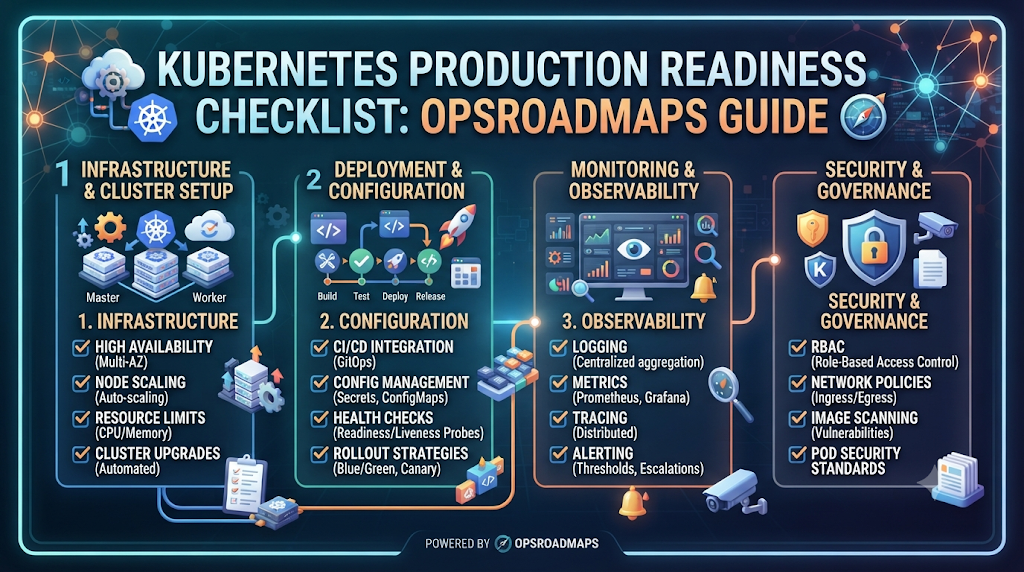
A Kubernetes production readiness checklist is a practical list of checks you run before or during live operation. It confirms that your cluster, workloads, and team habits can handle real traffic. Think of it like checking brakes and lights before a long road trip.
Engineers also pair checklist work with a broader production readiness assessment and a DevOps maturity assessment. Those reviews look at how code moves from commit to live traffic and how well teams automate tests and releases.
Together, these checks turn vague goals into concrete tasks. Teams see what is ready today and what needs work before launch.
Why the Topic Matters
Modern apps often split into dozens of small services running on cloud nodes. A single bad setting or missing limit can slow down or break an entire feature. Fixing outages after customers complain costs time, money, and trust.
Growing teams regularly run into four common roadblocks:
- Sudden pod restarts: Missing limits or bad configs cause containers to crash over and over.
- Unclear on-call steps: Engineers waste minutes guessing who owns a broken service.
- Rising cloud bills: Idle nodes and oversized instances quietly drain monthly budgets.
- Blind spots during alerts: Too many noisy warnings hide the real problem.
Structured checks catch these risks early. Teams gain clearer priorities and fewer late-night emergencies.
Core Concepts and Components
Reliable container operations depend on several connected practices. You do not need to fix every area at once, but each piece supports the others.
- Cluster and workload checks: Verify CPU and memory requests, health probes, node scaling, and backup restores.
- Container crash recovery: Use steady Kubernetes CrashLoopBackOff troubleshooting to spot bad startup commands, missing secrets, or out-of-memory kills.
- Reliability targets: Follow an SRE adoption roadmap to set uptime goals, error budgets, and blameless reviews.
- Outage response: Use an incident management maturity model to speed up triage, clear updates, and post-incident learning.
- Security guardrails: Apply a DevSecOps implementation roadmap to scan images, check secrets, and limit cluster permissions early.
- System visibility: Grow along an observability maturity model to link metrics, logs, and traces across services.
- Internal self-service: Build a platform engineering adoption roadmap with safe templates so developers ship faster.
- Spend control: Follow a cloud cost optimization roadmap to right-size compute and remove unused cloud resources.
Step-by-Step Guide
You can put a practical readiness routine in place using six clear steps:
- Pick one production workload. Choose an app that matters to users so your checks stay focused.
- Audit resource and health settings. Set CPU and memory requests and limits, plus liveness and readiness probes.
- Test failure and recovery. Simulate a pod or node failure and verify traffic shifts cleanly without user errors.
- Check security and access. Restrict cluster roles, scan container images, and store secrets outside plain code.
- Wire up alerts and runbooks. Connect key metrics and logs to actionable alerts with short step-by-step fix notes.
- Review every quarter. Re-run your checklist as traffic grows and update templates when lessons change.
Benefits and Challenges
A clear readiness process brings practical benefits. Teams often see fewer repeat outages, faster onboarding for new engineers, and smoother release days. Leaders also get a clearer view of operational risk and cloud spending.
At the same time, real challenges exist. Writing a checklist does not fix broken systems on its own. If teams treat it as a rubber stamp instead of a real check, important risks can slip through.
Best Practices
- Focus on high-risk checks. Keep items tied to real failure modes rather than busywork.
- Automate checks in CI/CD. Catch bad manifests and missing probes before code reaches the cluster.
- Keep runbooks short. Write clear steps that an engineer can follow calmly during an alert.
- Practice incident drills. Run regular game days so teams know how to respond before a real outage hits.
- Review cloud waste often. Check node usage and storage leftovers so costs match real demand.
Common Mistakes
- Skipping resource limits. Pods without limits can hog node memory and knock neighbors offline.
- Ignoring readiness probes. Traffic can hit a pod before the app finishes starting up.
- Copying giant checklists blindly. A complex setup built for huge teams can slow down a small group.
- Treating security as an afterthought. Adding checks right before launch creates last-minute delays and stress.
Realistic Example
Imagine a team running an order tracking service on Kubernetes ahead of a busy product drop. During past spikes, pods restarted unexpectedly and engineers scrambled to find recent logs.
The team runs a Kubernetes production readiness checklist on the service and its cluster. They find missing memory limits, no readiness probe, and noisy alerts without clear runbooks.
Over two weeks, they add memory limits, configure readiness probes, clean up alert rules, and test a pod restart. During the product drop, traffic spikes smoothly and the team resolves one minor config issue in minutes.
FAQs
1. What is the main purpose of a Kubernetes production readiness checklist?
It helps teams verify that a cluster and its workloads are reliable, secure, and ready for real traffic before or after launch.
2. How does a production readiness assessment differ from a DevOps maturity assessment?
A production readiness assessment checks whether a specific service or system is ready for live traffic, while a DevOps maturity assessment reviews broader team workflows, automation, and delivery habits.
3. Why should every Kubernetes deployment set CPU and memory limits?
Limits prevent one misbehaving container from consuming all node resources and disrupting other workloads on the same host.
4. What is the first step in Kubernetes CrashLoopBackOff troubleshooting?
Check recent pod events and container logs to see whether the app is crashing on startup, missing a config or secret, or hitting a memory limit.
5. What does an SRE adoption roadmap focus on?
It focuses on defining reliability targets, tracking error budgets, reducing repetitive manual toil, and learning from incidents without blame.
6. How does a platform engineering adoption roadmap help application teams?
It provides self-service tools, golden paths, and tested templates so developers can deploy safely without learning every infrastructure detail.
7. Why is an incident management maturity model useful during outages?
It defines clear roles, communication steps, and severity levels so teams respond faster and reduce confusion under pressure.
8. What role does a DevSecOps implementation roadmap play in container work?
It embeds image scanning, secret checks, and least-privilege access rules into daily builds instead of waiting until release day.
9. How does an observability maturity model improve debugging?
It helps teams move from isolated logs to connected metrics, logs, and traces that pinpoint slow or failing services quickly.
10. When should teams start a cloud cost optimization roadmap?
Teams should start early and review regularly so idle clusters, oversized nodes, and unused storage do not quietly inflate bills.
Conclusion
Reliable container operations come from steady habits, not last-minute fixes. A focused Kubernetes production readiness checklist helps teams spot weak spots early and build calmer releases.
Start with one critical service, fix your top risks step by step, and review your setup each quarter. Consistent preparation keeps systems steady as your team and traffic grow.
Leave a Reply