Advancing Enterprise Software Delivery with Kubernetes Certified Administrator & Developer (KCAD) Competencies
Introduction
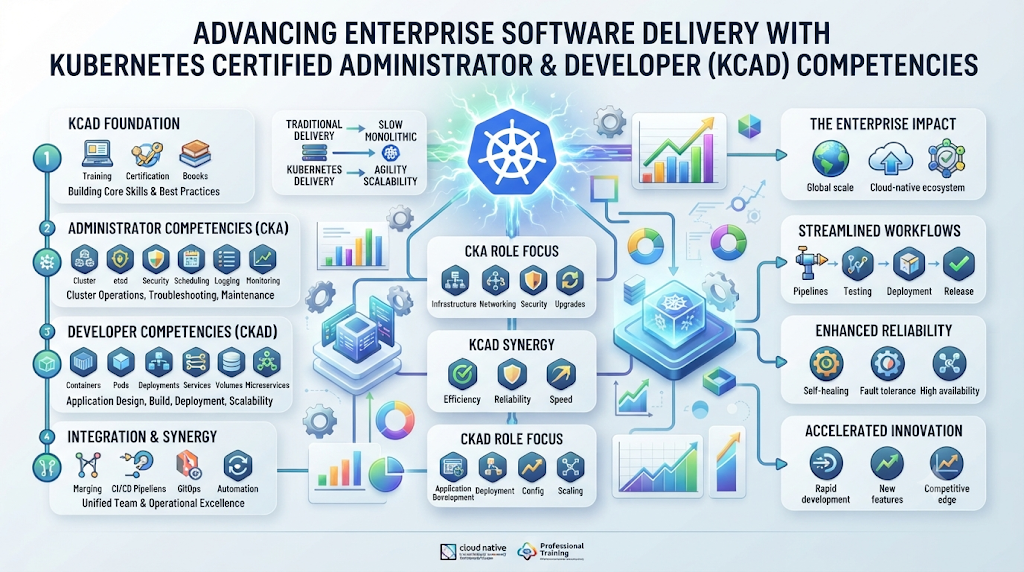
In the current era of distributed computing, software delivery velocity dictates market success. Traditional boundaries separating infrastructure operations from software engineering have vanished, replaced by unified cloud-native workflows where applications and their underlying hosting environments are engineered together. The Kubernetes Certified Administrator & Developer (KCAD) model captures this modern philosophy perfectly. By merging cluster administration with application engineering, this dual-focus paradigm equips practitioners to handle both the platform layer and the workload layer with equal confidence. This comprehensive guide explores the KCAD landscape from an advanced engineering and operational viewpoint, examining core architectures, vital technical skills, hands-on workflows, and career trajectories.
What Is Kubernetes Certified Administrator & Developer (KCAD)?
The KCAD framework represents a departure from narrow technical specializations toward a holistic, end-to-end cloud competence.
Unifying Operations and Code
Historically, system administrators managed servers while software developers wrote application code, frequently causing friction during production releases. The KCAD mindset eliminates this divide. It mandates that a skilled cloud professional understands how manifest configurations trigger control plane actions, how resource quotas govern scheduling, and how container networking maintains system availability.
Bridging Theory and Production
By validating both sides of the container lifecycle, this credential ensures that applications are engineered with operational realities in mind, and that clusters are provisioned to support complex workload demands.
What Is Kubernetes?
Kubernetes serves as the foundational operating system of the cloud, translating declarative configuration files into living, scalable distributed applications.
Core Concepts Explained
- Containers: Lightweight, portable execution packages bundling code and runtime dependencies.
- Container Orchestration: Automated systems managing the scheduling, scaling, and lifecycle of container fleets.
- Kubernetes Cluster: A collective pool of computational, networking, and storage resources.
- Control Plane: The central governance brain overseeing cluster state and scheduling decisions.
- Worker Nodes: The processing muscle executing application containers.
- Pods: The fundamental scheduling units wrapping one or more containers.
- Services: Stable network abstractions routing traffic internally and externally.
- Deployments: Declarative automation engines managing zero-downtime application rollouts.
- Namespaces: Logical boundaries partitioning multi-tenant resources within a shared cluster.
Kubernetes succeeds because it replaces manual deployment scripts with self-healing control loops that maintain desired system states automatically.
Why Kubernetes Skills Matter
Enterprise organizations adopt container orchestration to solve the inherent availability and scaling challenges of distributed software:
- Declarative Automation: Specifying desired system states rather than manual execution steps.
- Elastic Capacity Scaling: Adjusting compute resources dynamically to match shifting workload demands.
- Automated Fault Tolerance: Detecting container or node failures and routing traffic around them instantly.
- Resource Density: Packing multiple microservices safely onto shared infrastructure to minimize costs.
KCAD Certification Overview
From an evaluation standpoint, professional Kubernetes assessments prioritize practical execution over theoretical memorization.
- Assessment Format: Terminal-based, performance-driven practical problem solving
- Core Focus: Cluster maintenance, manifest engineering, network troubleshooting, and security
- Environment: Live, interactive container clusters under strict time constraints
Always verify current official guidelines, exam prerequisites, and renewal criteria directly through authorized certification portals before registering.
Who Should Take KCAD?
This certification framework speaks to forward-thinking practitioners across the technology spectrum:
- DevOps & Platform Specialists: Unifying infrastructure automation with developer productivity.
- Software Architects: Designing resilient microservices optimized for distributed orchestration.
- Site Reliability Engineers: Safeguarding production uptime, observability, and disaster recovery.
- Infrastructure Engineers: Expanding their expertise into application-layer interactions.
Eligibility and Prerequisites
Establishing a solid technical foundation before diving into advanced container orchestration ensures a smoother learning curve:
- Operating System Literacy: Comfort with Linux command-line utilities and file permissions.
- Networking Fundamentals: Grasping IP addressing, port routing, and DNS mechanisms.
- Container Runtimes: Experience building and executing container images locally.
- Declarative Formats: Proficiency in structuring and writing YAML documents.
Skills You Can Gain
Adopting the KCAD framework instills powerful engineering habits:
- End-to-End Diagnostics: Tracing application failures from container logs down to node-level resource bottlenecks.
- Declarative Lifecycle Management: Managing complex multi-container rollouts with absolute confidence.
- Defensive Configuration: Enforcing least-privilege security policies across isolated namespaces.
- Resource Fine-Tuning: Allocating precise CPU and memory constraints for optimal cluster performance.
Kubernetes Architecture
An architectural breakdown reveals how control plane decisions translate into physical node operations.
| Component | Type | Primary Function |
| API Server | Control Plane | Serves as the primary REST gateway for all administrative and automated requests. |
| etcd | Control Plane | Acts as the consistent, secure key-value store for all cluster state data. |
| Scheduler | Control Plane | Evaluates resource availability to place new pods on optimal worker nodes. |
| Controller Manager | Control Plane | Continuously reconciles actual cluster state with desired configurations. |
| Kubelet | Worker Node | Enforces pod specifications locally on individual host servers. |
| Kube-proxy | Worker Node | Manages packet forwarding and network routing rules. |
| Container Runtime | Worker Node | Pulls and executes container processes safely on the host node. |
Kubernetes Administration Skills
Maintaining a robust cluster requires proactive oversight and precise operational governance:
- Cluster Lifecycle Management: Overseeing node upgrades, capacity planning, and maintenance draining.
- Multi-Tenant Governance: Enforcing resource quotas and namespace isolation for different business units.
- Storage Orchestration: Provisioning persistent volume claims for stateful application data.
- Network Segmentation: Enforcing firewall-like rules using cluster network policies.
Kubernetes Developer Skills
Building applications for Kubernetes requires embracing cloud-native design patterns and resilient coding habits:
- Manifest Engineering: Crafting clean, reusable YAML templates for application workloads.
- Configuration Externalization: Decoupling code logic from environment settings using ConfigMaps and Secrets.
- Health Probes: Implementing liveness, readiness, and startup checks for automated self-healing.
- Rolling Updates: Executing zero-downtime updates and rapid rollbacks.
Kubernetes Workloads and Objects
Selecting the correct workload abstraction is critical for sound application architecture:
- Pods: Ideal for single-purpose containers or tightly bound helper sidecars.
- Deployments: The standard choice for scalable stateless web apps and APIs.
- StatefulSets: Essential for databases requiring persistent network identities and ordered scaling.
- DaemonSets: Perfect for running cluster-wide logging and monitoring agents.
- Jobs & CronJobs: Executing scheduled administrative batch processing tasks.
Kubernetes Networking
Kubernetes networking establishes a flat, secure communication fabric across distributed nodes:
- Pod-to-Pod Communication: Direct IP-to-IP connectivity without network address translation overhead.
- Cluster Services: Stable internal load balancing across dynamic pod sets.
- Ingress Controllers: Efficiently routing external HTTP/S traffic into internal microservices.
- Network Policies: Restricting unauthorized traffic paths between sensitive pod groups.
Kubernetes Storage
Bridging ephemeral containers with durable storage requires robust volume abstractions:
- Volumes: Temporary scratch spaces tied directly to individual pod lifecycles.
- Persistent Volumes (PV): Cluster-level storage pools provisioned independently by administrators.
- Persistent Volume Claims (PVC): Workload-specific requests for storage allocation.
- Storage Classes: Dynamic backends defining performance tiers and replication policies.
Kubernetes Security
Enterprise security must be embedded at every layer of the container stack:
- Access Control: Enforcing strict Role-Based Access Control (RBAC) to limit user and service permissions.
- Secret Protection: Encrypting sensitive credentials securely away from source code repositories.
- Pod Security Standards: Preventing privilege escalation and container breakout vulnerabilities.
Kubernetes Troubleshooting
Effective troubleshooting relies on systematic root-cause analysis across the cluster stack:
- Investigating Crashes: Using inspection commands to read container exit logs and crash loops.
- Resolving Scheduling Blocks: Examining resource requests against available node capacity.
- Verifying Connectivity: Testing internal DNS lookup and service selector matching.
Kubernetes Monitoring and Observability
Observability transforms opaque clusters into transparent, predictable systems through telemetry:
- Metrics Collection: Tracking CPU, memory, and network saturation over time.
- Log Aggregation: Centralizing stdout streams for auditing and debugging.
- Event Tracking: Monitoring control plane state transitions and system warnings.
Real-World Kubernetes Workflow
A professional engineering workflow follows an iterative, automated lifecycle:
- Package application source code into a secure container image and push to a registry.
- Define desired application architectures using declarative YAML manifests.
- Apply configurations to the deployment cluster using automated tooling.
- Monitor system telemetry, resource utilization, and application logs.
- Scale workloads dynamically or execute seamless rolling updates.
Hands-on Projects for KCAD Preparation
Practical projects translate architectural theory into actionable muscle memory:
- Multi-Tier Application Deployment: Deploy a web application connected to a persistent database.
- Configuration Management: Inject application settings using ConfigMaps and Secrets.
- Security Policy Enforcement: Implement restrictive network policies between pod groups.
- Probe Configuration: Add custom health probes to test automated container recovery.
Benefits of KCAD Certification
Viewing professional certification through an architectural lens yields significant career advantages:
- Validates comprehensive understanding of the entire container lifecycle.
- Enhances problem-solving agility during high-pressure production incidents.
- Demonstrates readiness to contribute to complex cloud-native engineering initiatives.
KCAD Certification Preparation Roadmap
- Master Linux administration and fundamental container runtime concepts.
- Study control plane architecture and data flow mechanics.
- Practice writing declarative manifests for core Kubernetes objects.
- Set up an isolated test environment to experiment with networking and storage.
- Simulate timed troubleshooting and recovery scenarios.
- Review official documentation to reinforce edge-case knowledge.
Study Resources and Preparation Tips
- Official Documentation: Consult authoritative references for precise syntax and design patterns.
- Interactive Environments: Practice commands repeatedly in live terminal sandboxes.
- Architecture Diagrams: Draw out control plane interactions to solidify conceptual understanding.
Common Mistakes to Avoid
- Treating Kubernetes clusters like traditional virtual machine infrastructure.
- Ignoring security policies and default network isolation rules.
- Neglecting hands-on terminal practice in favor of passive reading.
Career Opportunities and Job Roles
- Cloud Platform Engineer: Designing internal developer infrastructure and portals.
- DevOps Practitioner: Streamlining deployment pipelines and cluster automation.
- Site Reliability Engineer: Ensuring high availability and disaster recovery readiness.
- Cloud-Native Architect: Shaping enterprise modernization and migration strategies.
Salary and Career Growth
Compensation in the cloud-native space reflects the scarcity of engineers who understand both infrastructure operations and application architecture. Professionals who bridge this gap effectively position themselves for high-impact technical leadership roles.
KCAD vs Related Certifications
| Certification | Main Focus | Level | Suitable For |
| KCAD (Dual Focus) | Administration & Application Development | Intermediate / Advanced | DevOps Engineers & Cloud Professionals |
| CKA | Cluster Administration & Infrastructure | Intermediate / Advanced | System Administrators & Infrastructure Engineers |
| CKAD | Application Design & Build | Intermediate | Software Developers & Container Specialists |
| CKS | Cluster Security & Hardening | Advanced | Security Engineers & DevOps Specialists |
Future of Kubernetes
The cloud-native landscape continues expanding into innovative paradigms:
- Platform Engineering: Creating curated developer portals atop raw Kubernetes primitives.
- GitOps Automation: Managing infrastructure state declaratively using version-controlled repositories.
- AI & Machine Learning Workloads: Scheduling intensive model training pipelines across distributed clusters.
Recommended Learning Path After KCAD
- Explore advanced cluster security and hardening certifications.
- Investigate service mesh architectures for fine-grained traffic control.
- Study GitOps continuous delivery workflows.
Key Takeaways
- Kubernetes unifies infrastructure management and application deployment.
- A dual-focus perspective creates versatile, highly effective cloud engineers.
- Practical terminal experience is irreplaceable when mastering distributed systems.
- Continuous learning ensures long-term mastery in the evolving cloud-native landscape.
FAQs
What core philosophy drives the KCAD perspective?
It emphasizes that operational administration and application development are deeply interdependent in modern cloud environments.
Who benefits most from adopting a dual-focus Kubernetes approach?
DevOps engineers, platform architects, and developers seeking complete visibility into production systems.
Why is declarative configuration preferred over imperative commands?
It ensures consistency, simplifies version control, and allows the control plane to reconcile desired state automatically.
How do pods differ from traditional virtual machines?
Pods share underlying kernel resources and container runtimes, making them significantly lighter and faster to provision.
What role does the control plane play in cluster stability?
It continuously monitors cluster state and executes corrective control loops when actual state deviates from desired state.
Why is persistent storage challenging in containerized environments?
Containers are ephemeral by default, requiring dedicated storage abstractions to preserve data across restarts.
How do network policies enhance cluster security?
They act as micro-segmentation firewalls restricting unauthorized pod-to-pod communication.
What is the significance of health probes in deployments?
They allow the orchestrator to automatically restart failed containers or stop routing traffic to unhealthy instances.
How does mastering Kubernetes impact long-term career growth?
It aligns professionals with modern industry standards, unlocking advanced roles in cloud architecture and platform engineering.
What comes after mastering foundational container orchestration?
Advanced specializations such as service mesh implementation, GitOps automation, and security hardening.
Conclusion
Viewing Kubernetes through an integrated administration and development lens transforms how engineers approach software delivery. By aligning infrastructure management with application design, teams build resilient systems capable of scaling effortlessly. Embracing hands-on experimentation and continuous architectural learning ensures long-term mastery in the evolving cloud-native ecosystem.
Leave a Reply