Visa Requirements for Indians: A Complete Applicant Preparation Guide
Introduction
Too many migration journeys are planned merely up to the day an entry visa is stamped into an Indian passport. Applicants invest immense energy, emotion, and capital into crossing the border, treating the arrival terminal as the finish line. In reality, stepping off the airplane is simply the conclusion of the preliminary administrative phase. The genuine challenge lies in ensuring that your legal status, career trajectory, family stability, and personal wealth compound positively over the next five to ten years.
When individuals fail to design their move around long-term settlement, they frequently find themselves trapped in regulatory dead ends: holding non-renewable temporary work permits, watching post-study work streams expire without an avenue to transition, or discovering that initial tax choices have created compounding liabilities across borders. Viewing relocation through a life-cycle perspective shifts your focus from short-term entry to durable residency, career growth, and generational security. This Immigration Guide for Indians explores the multi-year trajectory of moving abroad, detailing how to evaluate pathways for long-term viability, manage compliance across family transitions, and build a lasting life overseas. Resources on DesiNRI help families evaluate these milestones with clear, practical guidance.
Main Article
Evaluating Migration Categories by Long-Term Settlement Potential
Not every legal entry path offers a sustainable bridge to indefinite settlement or citizenship. If your personal goal is multi-year family integration, selecting a visa category requires auditing its statutory transition mechanisms before committing capital.
The major immigration frameworks offer fundamentally different settlement timelines:
- Direct Permanent Resident Entrants: Programs managed by Australia or Canada grant unconditional work rights, domestic healthcare access, and independent residency from day one. They offer the most stable platform for long-term wealth building, as your legal presence is completely decoupled from any single corporate sponsor.
- Corporate Employer-Tied Permits: Prevalent across North America, the United Kingdom, and the European Union, employer-sponsored routes provide valuable income immediately. However, their settlement value depends entirely on local conversion rules. If national regulations lack a clear pathway from temporary work permits to indefinite leave or permanent residency, you face recurring renewal risks and vulnerability to sudden economic contractions.
- Academic Multi-Stage Transitions: Commencing via higher education is a multi-step gamble. You move through consecutive statuses: international student, temporary graduate trainee, employer-sponsored specialist, and eventually permanent resident. Every single junction requires qualifying under future statutory rules that may change during your studies.
- Regional Endorsement and State Initiatives: These frameworks trade geographic flexibility for settlement security. By agreeing to reside and practice your profession in regional territories facing economic and labor shortages, you often gain access to clearer, faster pathways to permanent residency.
Evaluating your options through this multi-year lens prevents you from accepting visas that offer quick entry but lack sustainable options for long-term stay.
Strategic Permanent Residency for Indians: Auditing the Human-Capital Equation
Securing permanent resident status upfront provides the strongest foundation for long-term settlement. It establishes a secure platform that allows you to change employers, negotiate salaries from equal standing, and plan family milestones without fear of sudden status cancellations.
The True Role of a PR Points Calculator in Long-Term Planning
When mapping out skilled migration, many professionals treat an automated PR Points Calculator as a transactional test: enter metrics, see if the sum matches recent invitation rounds, and submit. From a long-term perspective, an automated calculator is actually a diagnostic instrument that reveals structural weaknesses in your profile over time.
Because human-capital matrices prioritize youth and language agility, every year of delay alters your score:
| Evaluation Metric | Long-Term Strategic Reality | Proactive Planning Response |
| Age Matrix | Maximum points are awarded between 25 and 32, declining after 33. | Complete foreign assessments and testing early, rather than waiting for an employer to sponsor you later in your 30s. |
| Educational Credentials | Destination frameworks award higher points for postgraduate degrees evaluated as locally equivalent. | Verify that five-year integrated or distance degrees from Indian institutions yield direct master’s equivalence. |
| Career Trajectory | Authorities only reward continuous, verifiable employment matching national occupational standards. | Ensure job title promotions within Indian firms reflect clear continuity in primary occupational codes. |
| Language Benchmarks | Standardized language bands (IELTS, PTE) serve as the single most adjustable variable in points calculations. | Target maximum competency tiers; high language results frequently offset lost points from age progression. |
| Spouse Integration | Accompanying partners who complete language tests and skill assessments add critical bonus points. | Treat migration as a dual-career project by aligning both partners’ paperwork simultaneously. |
| Regional Integration | State and provincial sponsorships provide substantial score bonuses in exchange for regional settlement. | Factor lower regional living costs and family-friendly schooling into your long-term wealth planning. |
Approaching Permanent Residency for Indians with a five-year horizon helps you build a strong, verified portfolio. When your paperwork is organized and verifiable, your points hold up under case-officer scrutiny.
Employer Sponsorship and Work Visa for Indians: Managing Career Autonomy
Employer-sponsored visas represent an established entry point into foreign corporate markets, but relying on them requires active risk management. A temporary visa creates a temporary power imbalance in your employment relationship that must be navigated thoughtfully.
Structuring Your Career on a Sponsored Permit
Converting a corporate job offer into an authorized Work Visa for Indians requires meeting specific regulatory benchmarks:
- Sponsor Authorization: The sponsoring enterprise must hold an active license with its national labor authority, demonstrating financial solvency and clean compliance records.
- Statutory Wage Compliance: Employment contracts must meet government-mandated prevailing wage thresholds, ensuring foreign specialists are not hired at substandard rates.
- Transition Deadlines: Most work visas provide a limited grace period (often 60 days) to secure an alternate sponsor or depart the country if employment ends.
- Roadmaps to Permanent Residency: Before accepting an overseas offer, review the legal mechanisms for transitioning from a temporary work permit to permanent resident status. If a role does not offer a pathway to permanent residency, treat it as a temporary contract rather than a permanent relocation.
Jobs Abroad for Indians: Building Resilient International Careers
Sustaining a multi-year career abroad requires targeting industries with genuine, long-term talent shortages rather than chasing temporary hiring surges.
- Target Structural Deficit Sectors: Direct your job search toward industries with persistent domestic labor deficits, such as healthcare infrastructure, clean energy systems, cloud architecture, and specialized engineering disciplines.
- Adapt to Regional Professional Standards: Rework your professional profile to match destination-country standards. Remove personal indicators like photographs, marital status, and age, highlighting instead verifiable project outcomes and technical specializations.
- Focus on Established Employers: Prioritize multinational corporations and established domestic companies with proven experience managing foreign worker visas over under-resourced firms unfamiliar with immigration compliance.
Protecting Your Family and Finances from Recruitment Fraud
The desire to secure an international role makes many candidates targets for sophisticated recruitment scams. Protect your personal data and capital by recognizing standard warning signs:
- Demands for Placement or Visa Fees: Authentic employers and reputable corporate recruiters never charge candidates fees for job placement, application processing, or visa petitions.
- Guaranteed Visa Outcomes: No private agency, recruitment consultant, or advisor can guarantee a visa approval; legal decisions rest solely with government case officers.
- Unprofessional Interview Channels: Legitimate multinational employers conduct comprehensive, multi-stage video and technical interviews before extending offers.
- Unverified Email Domains: Be skeptical of formal employment communications originating from generic webmail providers (such as Gmail or Yahoo) rather than verified corporate domain servers.
Higher Education as an Integration Pathway: Student Visa for Indians
International education provides valuable cultural adjustment and local academic credentials, but it should be planned as an educational investment rather than a transactional purchase of permanent residency.
Securing a Student Visa for Indians requires meeting two foundational legal standards: proving genuine academic intent and demonstrating unencumbered financial liquidity.
Life-Cycle Considerations for Student Migrants
- Direct Institutional Placement: Unconditional acceptance from an accredited, government-recognized foreign educational institution.
- Verified Financial Solvency: Demonstrable liquid capital to cover tuition obligations and living expenses, backed by seasoned bank savings, verifiable investments, or sanctioned bank education loans.
- Academic Continuity: A logical connection between your past academic qualifications and your proposed study program. Unexplained career gaps can draw scrutiny from reviewing officers.
- Statement of Purpose: A clear, factual statement detailing why the chosen program advances your career trajectory and confirming your understanding of statutory visa conditions.
Remember that student visa privileges are strictly temporary. Term-time working hours are capped by law, and post-study work entitlements depend entirely on prevailing regulations at the time of graduation.
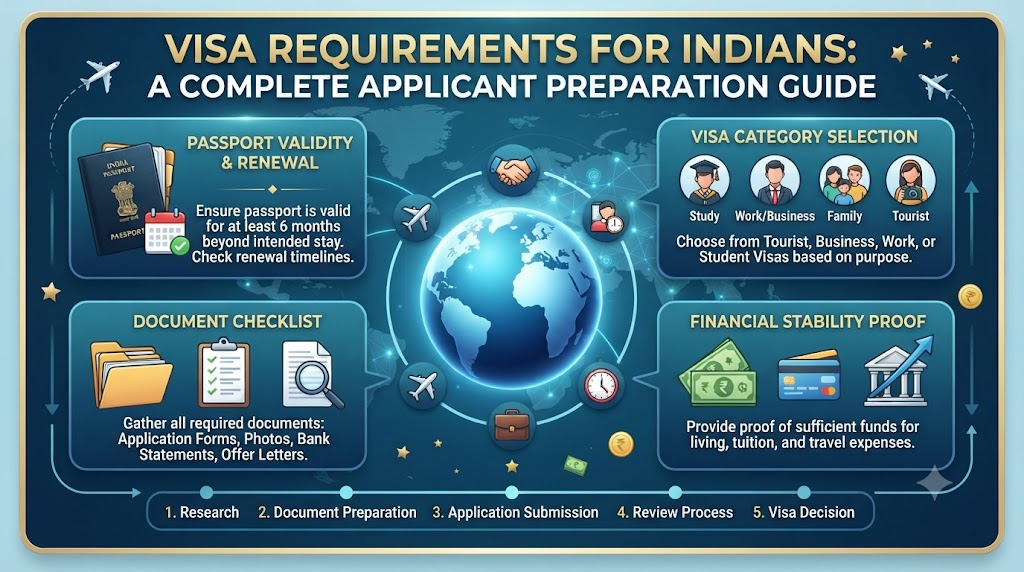
The Verifiable Visa Document Checklist
Administrative delays and application refusals rarely happen by chance; they occur when submitted documentation is incomplete, inconsistent, or untraceable. Use this comprehensive checklist to assemble an audit-ready portfolio:
[Civil Identity & Vital Records]
├── Current Valid Passport (minimum 6 months validity beyond travel dates)
├── Complete Historical Passports (showing past visas and travel stamps)
├── Official Municipal Birth Certificate (issued near the time of birth, naming parents)
└── Government Identity Records (Aadhaar, PAN cards establishing domestic tax history)

[Academic & Credential Evidence]
├── Degree & Diploma Certificates accompanied by consolidated semester grade sheets
├── Formal Academic Transcripts provided in sealed or authenticated digital formats
├── Credential Evaluation Reports (e.g., WES, ACS, VETASSESS)
└── Official Language Score Cards (IELTS, PTE) verifiable via secure online databases

[Professional History & Financial Tracing]
├── Work Experience Letters printed on authentic corporate stationery
│   └── (Detailing employment dates, weekly hours, salary, and day-to-day duties)
├── Initial Appointment Letters, Promotion Notices, and Relieving Letters
├── Consecutive Monthly Salary Slips (minimum 6–12 months per position)
├── Annual Income Tax Returns (ITR-V, Form 16) covering your claimed employment history
└── Bank Account Statements verifying continuous, direct salary credits from employers

[Financial Liquidity & Proof of Funds]
├── Six Months of Continuous Bank Statements bearing official branch seals and stamps
├── Fixed Deposit Certificates accompanied by bank balance confirmation letters
├── Loan Sanction Documentation issued by regulated banking entities
└── Clear Audit Trails accounting for any non-routine or substantial capital deposits

[Family & Dependent Documentation (If Relocating Together)]
├── Registered Marriage Certificate issued by a government registrar
├── Official Birth Certificates for all accompanying dependent children
└── Verifiable Proof of Shared Residence (joint leases, utility accounts, or shared bank statements)

[Statutory Clearances & Health Reports]
├── Police Clearance Certificates (PCC) issued by the Passport Seva Kendra
│   └── (Plus police clearances from any foreign nation where you resided >12 months)
├── Medical Assessment Results from embassy-approved panel physicians
└── Comprehensive Travel and Expatriate Health Insurance Coverage
Note: All original documents in regional Indian languages must include certified, notarized English translations. Personal identifiers—including name spellings, parental details, and dates of birth—must match across every piece of submitted evidence.
Step-by-Step Application Process
Submitting an immigration dossier requires methodical execution. While specific procedures depend on your destination country, an applicant-managed process follows eight logical stages:
- Strategic Feasibility Assessment: Review the official immigration statutes of your destination country. Verify that your age, credentials, occupation, and financial resources meet statutory minimums before spending money on third-party services.
- Credential and Skills Evaluation: Submit your academic records and employment verification letters to the destination country’s designated assessing body to confirm foreign equivalency.
- Standardized Language Testing: Take the required standardized language examinations (such as IELTS or PTE) and aim for scores that maximize your points or satisfy minimum statutory requirements.
- Lodging an Expression of Interest (EOI): Submit your profile to the destination government’s candidate pool, or have your approved employer lodge a formal sponsorship petition.
- Managing the Invitation to Apply (ITA): Once you receive an invitation or sponsorship clearance, assemble and submit your comprehensive visa application within the statutory window (often 60 days).
- Government Fee Payment: Remit all required application processing fees, dependent surcharges, and compulsory healthcare levies via approved international payment methods.
- Biometric Collection and Medical Clearances: Complete your digital fingerprinting, identity photographs, and medical evaluations at designated visa application centers.
- Visa Grant Review and Settlement Planning: Upon receipt of your formal visa grant notice, review all attached conditions, travel deadlines, and work permissions carefully before booking flights.
Long-Term Settlement Realities for Indians Living Abroad
A visa approval is simply a permit to enter a foreign jurisdiction; building a stable, productive daily life is a completely separate undertaking.
Practical Realities for New Migrants
- The Rental Market: Securing housing in major destination cities is competitive and requires extensive documentation. Plan for temporary furnished accommodation for your first four to six weeks while you attend in-person property viewings.
- Rebuilding Credit from Scratch: Your domestic credit history in India does not carry over to foreign bureaus. Open a local checking account immediately upon arrival and use an entry-level credit card responsibly to establish a domestic credit score.
- Healthcare Logistics: Learn how the host country’s medical system works. Complete your registrations with local primary care doctors or community clinics early so you can access non-emergency medical care when needed.
- Taxation and Banking Reclassification: Understand your tax residency status under local laws and relevant Double Taxation Avoidance Agreements (DTAA). Update your Indian bank accounts to Non-Resident Ordinary (NRO) or Non-Resident External (NRE) status to comply with Indian foreign exchange regulations.
Engaging with the NRI Community
Connecting with the local NRI Community offers valuable practical support during your initial months. Local cultural organizations, professional associations, and diaspora networks can provide practical advice on finding accommodation, understanding school catchment zones, and navigating public transportation. Use community groups for practical, everyday tips, but always verify visa, tax, and employment rules through official government sources.
Practical Example / Application Scenario
Here is an example of an evidence-first approach in practice:
An Indian infrastructure engineer with six years of experience and a Bachelor of Engineering degree plans to immigrate via a points-tested skilled migration pathway.
Stage 1: Profile Audit
└── Matches current job duties against the official occupational description of the destination country.
└── Confirms their university degree holds direct equivalency under foreign academic benchmarks.

Stage 2: Evidentiary Assembly
└── Gathers detailed experience letters from past employers explicitly detailing core technical duties.
└── Compiles matching Form 16 records and bank statements showing continuous, verified salary credits.
└── Secures a positive skills assessment verifying their work history and degree.

Stage 3: Testing & Expression of Interest
└── Sits for the PTE examination, achieving superior bands to maximize points.
└── Submits an Expression of Interest, claiming points backed strictly by audited documents.

Stage 4: Clearances & Statutory Requirements
└── Applies for a Police Clearance Certificate (PCC) through the local Passport Seva Kendra.
└── Holds required settlement funds in an established, verifiable bank account.

Stage 5: Final Submission
└── Receives an official Invitation to Apply (ITA).
└── Submits all audited records, completes biometrics, and attends medical exams with panel doctors.
By assembling their paperwork before submitting their profile, the applicant avoids unnecessary delays and ensures their application is supported by solid evidence.
Key Takeaways
- Match Duties, Not Titles: Immigration authorities evaluate your actual daily responsibilities, not just your corporate job title. Ensure your experience letters accurately describe what you did.
- Calculators Are Only Estimators: Use points calculators to identify potential strengths and weaknesses, but remember that formal points depend entirely on your submitted proofs.
- Reconcile Financial Trails: Check that your employment letters, monthly salary slips, tax filings, and bank statements tell a consistent, uninterrupted story.
- Treat Visas and Jobs Separately: An overseas employment offer is a commercial agreement; it does not grant work authorization until the destination government approves the visa petition.
- Budget for Hidden Upfront Costs: Plan for out-of-pocket expenses such as language exams, professional credential assessments, certified translations, medical clearances, and initial living reserves.
- Rely on Official Government Portals: Cross-reference all rules, deadlines, and fee schedules with official government immigration websites rather than relying on unverified forum advice.
10 Frequently Asked Questions
What are the primary visa requirements for Indians moving abroad?
Requirements depend on the destination country and visa category. Typically, applicants must submit an unexpired passport, evaluated educational credentials, verifiable employment references, standardized language test scores, proof of adequate financial resources, an official police clearance certificate, and a medical evaluation conducted by an authorized physician.
How does a PR Points Calculator work for skilled migration?
A PR points calculator estimates an applicant’s competitive ranking by assigning numerical values to factors like age, level of education, professional work experience, language proficiency, and spouse qualifications. This estimate serves as an initial benchmark; official points are confirmed only after an immigration case officer examines your verified evidence.
Can an Indian citizen secure permanent residency without an initial job offer?
Yes. Countries such as Australia (Subclass 189/190) and Canada (Express Entry Federal Skilled Worker Program) feature points-based permanent residency pathways that do not mandate an advance job offer. These programs evaluate applicants primarily on personal human-capital metrics, including education, age, language skills, and documented work experience.
What distinguishes a temporary work visa from permanent residency status?
A work visa grants temporary permission to live and work in a specific country, frequently tying your stay to a sponsoring employer. Permanent residency grants indefinite authorization to reside, work, and study anywhere within that nation, offering greater employment flexibility and access to public healthcare systems.
What is the standard processing time for skilled immigration applications?
Processing schedules vary widely from a few months to more than a year depending on the visa category, total application volumes, and the time needed to verify background information. Most official immigration departments regularly publish and update estimated processing timelines on their primary websites.
What types of funds meet the financial proof requirements for immigration?
Immigration authorities generally accept liquid, readily accessible funds. Acceptable proofs usually include balances in savings accounts, verified fixed deposits, and formally disbursed education loans from regulated financial institutions. These funds must typically be supported by bank confirmation letters, statements, and clear audit trails showing the money is unencumbered.
Can my family accompany me under a skilled work or study visa?
In most countries, primary applicants on skilled work or post-graduate visas can bring immediate family members, which includes a legally married spouse and dependent children. However, regulations concerning dependent work permissions, public education fees, and minimum financial maintenance vary by country.
Why do immigration departments scrutinize employment reference letters so closely?
Immigration officers review employment references to confirm that your actual day-to-day responsibilities match the legal definitions of the occupation you are claiming. The letters must appear on official company letterhead and detail your job title, dates of employment, weekly working hours, compensation, and specific duties, backed by matching tax forms or pay slips.
What are the primary warning signs of an overseas recruitment scam?
Common warning signs include demands for advance placement fees, job offers extended without formal technical interviews, promises of guaranteed visa approvals, and communication sent from generic email providers like Gmail or Yahoo rather than registered corporate domains. Legitimate recruiters do not charge candidates for job placement.
Where should Indian applicants check current immigration rules and policies?
Always check official government immigration department websites, such as Immigration, Refugees and Citizenship Canada (IRCC), the Australian Department of Home Affairs, UK Visas and Immigration (UKVI), or official embassy web pages. These sources provide current, accurate rules and avoid the outdated information often found on third-party forums.
Conclusion
Relocating overseas is a complex undertaking that requires practical preparation, thorough documentation, and realistic expectations. While shifting immigration policies and competitive selection pools can seem daunting, you can navigate the process effectively by adopting a disciplined, evidence-based approach. Evaluate your options carefully, assemble your financial and employment documentation with attention to detail, and budget realistically for both application fees and your first few months abroad. By relying on official guidelines and preparing your evidence thoroughly, you can make informed decisions that support your long-term goals.
Leave a Reply