A Simple Practical Guide To Understanding Modern Enterprise Data Operations
Introduction
Have you ever wondered how apps know what movies you like or how stores keep track of items? It all happens with information called data. In the digital world, data moves like clean water flowing through pipes into a busy kitchen. If dirt gets into the pipe, dinner is ruined! Modern companies face a big challenge because they deal with giant floods of numbers, names, and clicks every single minute. When these pipelines break, business decisions stop completely. Learning modern data operations helps engineers build reliable plumbing for information so teams can work together smoothly. Educational communities like TheDataOps.org show how teams turn raw, messy data into helpful answers without constant breakdowns or stress.
Understanding What Data Operations Means
Data operations, often called DataOps, is a way of working that helps teams deliver clean information faster and more reliably. Think of it like a smart factory assembly line. Instead of building toy cars, this factory builds reports, charts, and smart answers. In traditional setups, data engineers build pipelines, analysts check charts, and IT teams run servers. When something breaks, everyone blames each other. DataOps brings these people together using teamwork, automated tests, and smart tools. It borrows ideas from factory manufacturing and software development so everyone follows clear, shared steps every day.
The Core Ideas Behind The Practice
Three main ideas make this way of working successful:
- Agile teamwork: Working in small, quick steps instead of waiting months to share results.
- DevOps automation: Using smart tools that build, test, and move information automatically.
- Total quality checks: Watching information closely at every step to catch mistakes early.
A Simple Factory Example
Imagine a bakery that makes thousands of cookies each morning. If nobody checks the flour, sour cookies might reach the store shelves.
A DataOps approach puts a tiny sensor right at the flour bin to test quality immediately. If something looks wrong, the machine pauses and alerts the baker. This simple idea keeps bad ingredients from ruining the entire batch of cookies.
How A Modern Data Pipeline Works
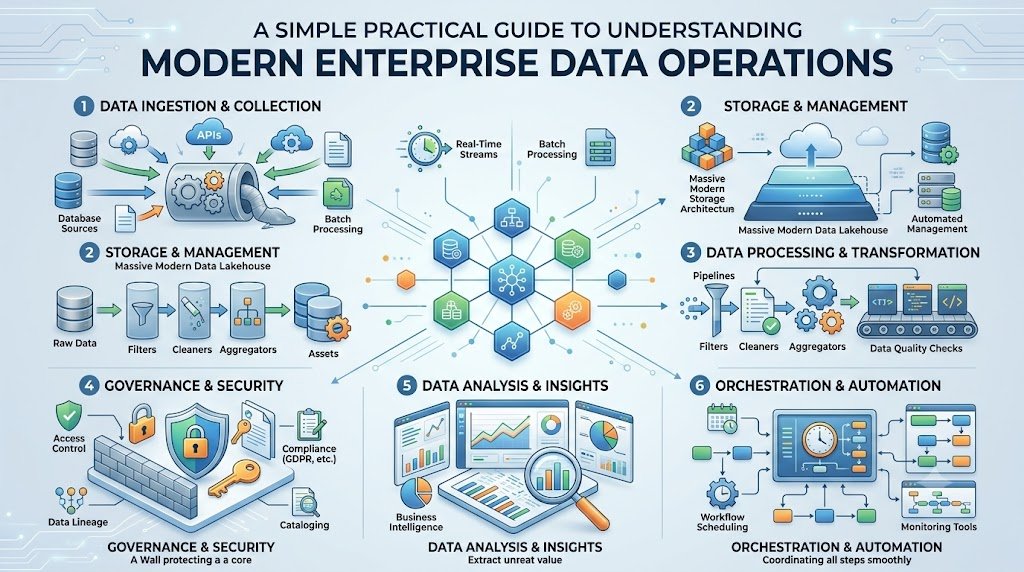
A data pipeline is simply a series of steps that moves information from where it is created to where people can use it. Without automation, people must copy files by hand, which leads to silly human mistakes.
Data pipeline automation takes away boring manual chores. Automated scripts run on a schedule, pull files, clean up spelling errors, and load the clean records into storage.
When pipelines run automatically, workers do not need to wake up at midnight to fix broken file transfers. The automated system does the heavy lifting while people focus on solving fun problems.
| Stage Name | What Happens In This Stage | Helpful Tool Examples |
| Ingestion | Gathers raw numbers, logs, and user events | Apache Kafka, Python scripts |
| Processing | Cleans messy text, fixes dates, and filters errors | Apache Spark, Hadoop clusters |
| Orchestration | Schedules each task in the exact right order | Apache Airflow |
| Monitoring | Checks pipeline speed and rings an alarm if steps fail | Grafana, cloud dashboards |
Why Quality And Visibility Matter
Getting data quickly is useless if the numbers are wrong. Imagine your school report card showing an F instead of an A simply because a computer script added two numbers incorrectly!
Data quality management ensures information stays accurate, complete, and trustworthy. Teams write automated checks that verify numbers before anyone can view them. If an order total is negative, the system stops the file right away.
Data observability works like an x-ray machine for your pipelines. It does not just check if a pipeline finished; it checks how healthy the pipeline was along the way. Observability watches five key signals:
- Freshness: Did the information arrive on time?
- Volume: Did all expected rows arrive, or did half disappear?
- Schema: Did someone suddenly change column names without telling anyone?
- Distribution: Do the numbers look normal or strangely high?
- Lineage: Where did this specific number travel from start to finish?
Everyday Tools And Technologies
Building strong data systems requires the right set of tools. No single application does everything, so engineers combine different technologies to create a complete platform.
Engineers use Python to write custom cleaning rules. They use Apache Airflow to decide which task runs first, second, and third. If millions of website clicks happen in seconds, Apache Kafka catches them like an oversized catcher’s mitt. When large files need heavy math, Apache Spark divides the work across many computers so the job finishes in minutes.
Containers managed by Kubernetes let these tools run on any cloud platform without crashing. Once the information is sparkling clean, tools like Tableau and Power BI display bright charts that help business leaders make smart choices.
How To Build A Career In Data Operations
Because every business relies on information, skilled specialists are in high demand across the globe. Becoming a DataOps engineer means you get to be the master architect of reliable data flows.
A helpful learning path includes:
- Learn basic coding with Python and database commands using SQL.
- Practice building simple data pipelines that move files from one folder to another.
- Learn how containers work using Docker and cloud virtual servers.
- Practice writing automated tests that check for blank or broken rows.
- Explore scheduling tools like Apache Airflow to automate your daily scripts.
Studying structured DataOps training materials and earning a respected DataOps certification helps beginners prove their skills to hiring managers. Platforms like TheDataOps.org provide clear educational roadmaps, breaking down complex topics into easy, manageable lessons for ambitious learners.
Common Challenges Teams Face
Changing how people work is never completely easy. Teams often run into a few common hurdles when they start adopting these practices:
- Siloed departments: Software developers, database administrators, and business teams sometimes avoid talking to each other.
- Messy legacy systems: Older databases often lack simple ways to connect to modern automation tools.
- Fear of change: Teams used to doing things by hand might worry that automation is too hard to learn.
- Tool overload: Trying to install ten brand-new tools at once can confuse engineers instead of helping them.
Taking small steps, practicing open communication, and learning together solves most of these early hurdles.
Frequently Asked Questions
What is DataOps and why is it important for modern businesses?
DataOps is a collaborative data management practice that borrows ideas from Agile and DevOps to automate and improve data pipelines.
It is important because it prevents data errors, speeds up the delivery of analytics, and ensures business leaders make decisions using accurate, reliable information.
How does DataOps differ from traditional DevOps?
DevOps focuses on the rapid, reliable delivery of software code and applications.
DataOps focuses on the continuous delivery and quality control of data pipelines, managing both software code and unpredictable data inputs.
What is data pipeline automation and why do teams use it?
Data pipeline automation uses software scripts and scheduled workflows to collect, clean, transform, and load information without manual effort.
Teams use it to eliminate repetitive human errors, save engineering hours, and ensure data arrives on time every day.
What is the difference between data quality and data observability?
Data quality focuses on the values themselves, checking whether data is accurate, complete, and properly formatted.
Data observability monitors the entire health of the data system, tracking freshness, volume changes, pipeline failures, and schema updates to identify why an issue happened.
What core skills does an aspiring DataOps engineer need to learn?
A DataOps engineer needs basic programming skills in Python or SQL, alongside knowledge of version control tools like Git.
They also benefit from learning orchestration tools like Apache Airflow, container platforms like Docker and Kubernetes, and automated data-testing frameworks.
Which tools are most commonly used in enterprise DataOps?
Popular tools include Apache Airflow for scheduling tasks, Apache Kafka for streaming real-time events, and Apache Spark for heavy data processing.
Teams also frequently use Git for code versioning, Jenkins or GitLab for CI/CD automation, and Grafana for system monitoring.
How does DataOps help improve data governance and security?
DataOps builds security, access control, and compliance checks directly into automated pipelines instead of treating them as an afterthought.
This ensures sensitive data is masked, traced through clear lineage, and audited automatically every time it moves through a system.
Can small teams benefit from DataOps practices, or is it only for large enterprises?
Small teams benefit significantly because automated tests and scheduled pipelines reduce the daily burden of fixing broken data flows.
Starting small with basic version control and simple automated data checks saves growing companies from accumulating messy technical debt.
What role does Apache Airflow play in a DataOps workflow?
Apache Airflow acts as the central orchestrator that schedules and sequences pipeline tasks.
It ensures that data cleaning only begins after files finish downloading, and it triggers alerts immediately if any step fails.
Where can beginners start learning practical DataOps skills?
Beginners can start by practicing basic Python data transformations and writing simple automated validation checks using open-source libraries.
Following structured learning paths, exploring hands-on certification roadmaps, and engaging with educational resources on platforms like TheDataOps.org can help build strong foundational expertise.
Final Thoughts
Managing enterprise information does not have to be an endless headache of broken pipelines and incorrect reports. When teams embrace automation, continuous testing, and friendly cross-team collaboration, data flows smoothly and safely like fresh water. Anyone willing to learn can master these skills, from curious students to seasoned developers looking for a fresh challenge. Exploring training programs, practicing with open-source tools, and joining learning communities like TheDataOps.org will set you on the right path toward building dependable, modern data systems.
Leave a Reply