Modern DataOps Architecture: Core Principles, Frameworks, and Tools
Introduction
Data engineering teams frequently encounter broken production pipelines, silent schema alterations, and degraded dashboards that erode stakeholder trust. When data consumers detect errors before the engineering team does, operational processes require fundamental restructuring. Understanding what is DataOps provides the framework needed to eliminate these recurring failure modes. DataOps applies automation, agile principles, and continuous delivery mechanisms specifically tailored to data platforms. While software engineering has benefited from mature deployment workflows for decades, data environments present unique operational challenges, including stateful storage layers, shifting source schemas, and complex dependency graphs. This guide explores the foundational components of DataOps, examines how continuous integration and deployment function alongside data pipelines, outlines essential validation strategies, and reviews standard tooling. Whether you are an engineer seeking to enhance pipeline resilience or a technical leader evaluating structured learning through DataOpsSchool.com, the architectural patterns below provide a blueprint for production reliability.
Understanding DataOps: Beyond “DevOps for Data”
To understand what is DataOps, it helps to identify where conventional engineering methodologies fall short when applied to analytical workflows. A frequent misconception is that DataOps simply applies traditional DevOps tooling directly to data systems. While both disciplines prioritize automation, version control, and collaborative delivery, data environments introduce distinct variables that traditional application deployment strategies do not accommodate.
Traditional application code is typically stateless. If an application bug is deployed, reverting the commit and restarting the container fleet resolves the immediate incident. In contrast, data systems are inherently stateful. A flawed transformation query executed against a production data warehouse alters physical tables, corrupts downstream aggregates, and contaminates historical reporting layers. Reverting the bad code commit does not revert the mutated data; engineers must execute complex backfills and schema restorations to recover.
DataOps manages the intersection of code, infrastructure, and the data payload itself. It introduces automated testing for code transformations and data quality, programmatic environment isolation, schema migration governance, and operational observability across every stage of the data lifecycle.
The Core Challenges of Modern Data Environments
Data platforms expand rapidly in complexity as business operations scale. Without defined operational standards, teams routinely face persistent structural hurdles:
- Silent Data Corruption: Pipelines complete successfully with exit code 0, yet upstream business applications output null values, invalid foreign keys, or duplicated events that silently corrupt downstream models.
- Schema Evolution Gaps: An upstream transactional database team drops or renames a column without coordination, breaking extraction jobs and invalidating downstream analytical models.
- Lengthy Debugging Cycles: Root-cause analysis consumes days because pipelines lack end-to-end lineage tracing and intermediate artifact inspection.
- Environment Drift: Discrepancies between local development workspaces, staging environments, and production warehouses cause deployments to fail unexpectedly in production.
- Manual Operational Overhead: Engineers spend significant portions of their workweeks performing manual backfills, ad-hoc query validation, and manual data patching rather than building new capabilities.
Implementing a structured DataOps strategy directly addresses these vulnerabilities by converting manual, reactive interventions into automated, repeatable software engineering guardrails.
The DataOps Lifecycle: Core Stages
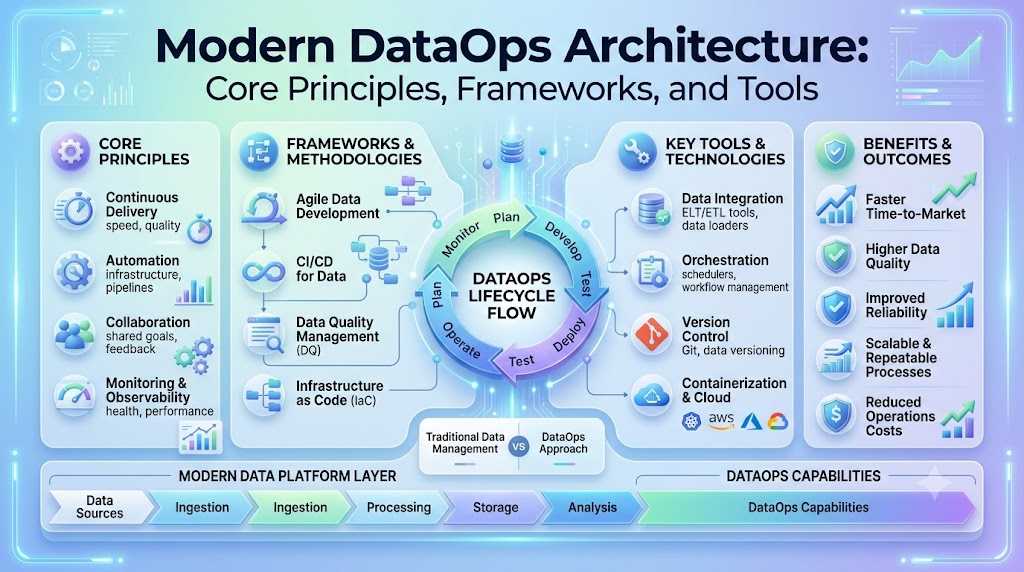
The DataOps lifecycle manages data as it transitions from raw operational events into business-ready analytical datasets. Each phase incorporates programmatic guardrails to safeguard processing integrity.
Data Sources → Ingestion → Storage → Transformation → Quality Validation → Deployment → Observability → Consumption
1. Ingestion and Extraction
Raw data is collected from transactional databases, external API endpoints, event streams, and flat file object stores. In a mature operational model, ingestion workflows dynamically capture source metadata, partition ingested files cleanly, and record high-water marks to guarantee idempotency during backfills.
2. Staging and Raw Storage
Data lands within cloud object storage or raw warehouse tables. At this stage, raw historical inputs remain immutable. Preserving raw inputs ensures that if transformation logic requires revision or pipelines fail downstream, original payloads can be reprocessed without querying operational source databases again.
3. Transformation and Modeling
Engineers clean, normalize, join, and aggregate datasets into dimensional or wide tables. Modern practices prioritize modular SQL transformations or distributed compute code maintained under Git version control, treating transformations as versioned software releases rather than ad-hoc database queries.
4. Automated Testing and Quality Validation
Before data is promoted to production consumption layers, automated validation suites evaluate data structures. The system checks schemas, confirms non-null constraints, validates uniqueness metrics, and ensures distribution thresholds fall within accepted operational bounds.
5. Deployment and Continuous Delivery
Data transformations, orchestration definitions, and infrastructure modifications are deployed through automated CI/CD pipelines. Workflows pass through linting, structural testing, and isolated staging runs before promotion into production environments.
6. Continuous Observability and Monitoring
Once pipelines run in production, automated observability agents continuously monitor execution duration, pipeline run status, data freshness, row volume variations, and schema integrity, routing alerts to on-call engineers when anomalies emerge.
Fundamental Pillars of DataOps
Continuous Integration and Continuous Delivery (CI/CD) for Data
Continuous integration in DataOps requires that every pipeline modification undergoes automated validation prior to merging into a primary branch. A standard DataOps CI/CD process implements specific testing layers:
[Developer Branch]
       │
       ▼
1. Static Code Analysis (SQLFluff / Black)
       │
       ▼
2. Automated Unit Tests (dbt-unit-test / PyTest)
       │
       ▼
3. Ephemeral Environment Creation (Isolated Schema / Virtual Warehouse)
       │
       ▼
4. Dry-Run Transformations (Zero-Copy Clone / Sampled Data)
       │
       ▼
5. Merge Approval & Automated Production Deployment
Data-specific continuous delivery requires isolated execution targets. Leading engineering teams leverage database cloning features (such as Snowflake zero-copy cloning or Databricks shallow clones) to spin up ephemeral staging environments during pull requests. This enables code to run against realistic data volumes and schemas without affecting production storage or compute limits.
Data Quality Verification
Data quality cannot be evaluated as an afterthought; it must be enforced programmatically at ingestion, transformation, and post-load phases:
- Syntactic Validation: Enforces strict structural boundaries, verifying that timestamps adhere to ISO formats, primary keys remain unique, and required payload fields are non-null.
- Semantic and Business Rule Validation: Asserts that calculated values align with business logic—such as confirming total transaction amounts never evaluate to negative values, or ensuring discount rates remain between 0 and 1.
- Statistical Anomaly Detection: Compares row insertion rates, mean metric shifts, and null percentage ratios against trailing historical distributions, identifying issues where volume spikes or drops precipitously.
SQL
-- Conceptual example of an inline assertion within transformation workflows
SELECT
    order_id,
    order_timestamp,
    customer_id,
    order_total_usd
FROM {{ ref('stg_orders') }}
WHERE order_total_usd < 0
   OR order_timestamp > CURRENT_TIMESTAMP();
-- In an automated framework, rows returned by this query fail the deployment build
Data Observability and Telemetry
Traditional infrastructure monitoring tracks server-level metrics: CPU utilization, available disk space, and network throughput. While valuable, these indicators can appear entirely healthy while pipelines process erroneous data.
Data observability monitors the operational health of the data flowing through the infrastructure:
- Freshness: Measures elapsed time since the dataset was last updated, verifying whether the pipeline meets defined Service Level Agreements (SLAs).
- Volume: Assesses whether expected row counts arrived or whether upstream source extraction dropped half of the expected batch.
- Schema Drift: Identifies altered column types, deleted fields, or new attributes introduced by upstream application releases.
- Lineage: Maps upstream dependencies and downstream consumers, allowing engineers to isolate root causes during incidents and evaluate blast radiuses before modifying models.
Architectural Trade-Offs in DataOps Implementations
| Architecture Layer | Traditional Approach | Modern DataOps Pattern | Engineering Trade-Offs |
|---|---|---|---|
| Transformations | Manual SQL runs / Stored Procedures | Version-controlled, modular ELT (e.g., dbt) | Higher initial setup effort; significantly reduced regression risk and maintenance overhead. |
| Testing | Ad-hoc manual verification queries | Automated pre-merge and in-pipeline assertions | Increases pipeline runtime slightly; catches data defects prior to downstream consumption. |
| Environments | Shared dev/test database schemas | Ephemeral schemas via automated CI cloning | Requires sophisticated CI scripting; prevents engineer collision and environment drift. |
| Failure Handling | Unmonitored job failure / User reports | Automated retries, dead-letter queues, active alerting | Increases orchestration design complexity; eliminates silent delivery failures. |
| Infrastructure | Manually configured compute clusters | Infrastructure as Code (IaC via Terraform) | Requires cloud infrastructure expertise; provides reproducible, auditable disaster recovery. |
Practical Workflow Example: Implementing Safe Pipeline Deployments
Consider an analytics team modifying a customer revenue attribution model. Under an ad-hoc workflow, an engineer modifies SQL logic locally and runs the script directly against the production analytical schema. If a join introduces a Cartesian product, historical revenue records duplicate instantly, corrupting executive dashboards.
In an automated DataOps environment, the workflow operates securely:
- Local Authoring: The engineer branches from main and adjusts transformation logic using modular SQL files.
- Pull Request Trigger: Opening a pull request invokes a CI pipeline via GitHub Actions or GitLab CI.
- Automated Ephemeral Creation: The CI workflow creates a temporary, isolated schema in the data warehouse using zero-copy cloning to mirror production structures without replicating physical storage costs.
- Validation Execution: The runner compiles the updated models, executes them against the cloned test dataset, and triggers automated assertions using frameworks like Great Expectations, Soda, or built-in tool validations.
- Code Review and Merging: Peer engineers review the structural changes, inspect execution logs, and approve the merge.
- Automated Production Run: Continuous deployment pipelines merge the code into the production branch, deploying updated artifacts and scheduling orchestration runs via tools such as Apache Airflow or Dagster.
Common DataOps Tools
Selecting tooling requires understanding the distinct functional responsibilities within modern data ecosystems:
Workflow Orchestration
- Apache Airflow: A widely utilized programmatic orchestrator using Python Directed Acyclic Graphs (DAGs) to define complex dependencies, retry logic, and monitoring hooks.
- Dagster: An orchestrator designed around data assets and software-defined data abstractions, providing native support for testing and resource parameterization.
- Prefect: A flexible workflow engine emphasizing dynamic task execution, fine-grained state management, and clear developer ergonomics.
Transformation and Modeling
- dbt (data build tool): Standardizes SQL transformations by introducing modularity, version-controlled testing, documentation compilation, and environment-driven deployments within cloud warehouses.
Data Quality and Assertion Frameworks
- Great Expectations: An open-source Python framework providing expressive, declarative assertions to validate, document, and profile data payloads.
- Soda: A lightweight data validation engine using human-readable assertion syntax to enforce data reliability standards across ingestion jobs.
Data Storage and Lakehouse Platforms
- Snowflake, Databricks, BigQuery, and AWS Redshift: High-performance analytical platforms that serve as the compute and storage backbone, offering isolation, autoscaling, and schema enforcement capabilities.
Infrastructure as Code (IaC)
- Terraform: Automates the provisioning of warehouse roles, analytical schemas, storage buckets, and access control policies across cloud providers to prevent manual configuration divergence.
Common Implementation Challenges and How to Solve Them
Adopting DataOps practices introduces operational and technical hurdles that require intentional solutions:
- Managing Pipeline Testing Costs: Running exhaustive integration tests against petabyte-scale production tables during every pull request generates unsustainable warehouse compute bills.
- Solution: Implement data sampling techniques, zero-copy structural clones, or lightweight synthetic datasets within CI pipelines to validate transformation logic without scanning entire historical tables.
- Handling Destructive Upstream Schema Shifts: Operational application updates frequently change source table schemas without warning, breaking extraction pipelines downstream.
- Solution: Establish contract-driven data practices using schema registries (such as Protobuf, Avro, or JSON Schema validation). Write pipelines that capture unexpected fields in quarantine schemas rather than halting execution entirely.
- Alert Fatigue from Fragile Thresholds: Overly sensitive data quality checks can generate dozens of notifications daily for harmless metric variations, training teams to ignore alerts.
- Solution: Tier alerting thresholds by severity. Route non-critical variations to informational logs while reserving high-urgency notifications for critical failures that affect core analytical workflows.
Common DataOps Mistakes to Avoid
- Focusing Exclusively on Tool Acquisition: Purchasing enterprise data observability platforms without establishing internal code review practices, testing guidelines, or operational ownership fails to improve pipeline reliability.
- Treating Data Testing as an Initial Milestone Only: Testing incoming data at ingestion is valuable, but failing to validate intermediate transformations allows joined or aggregated data to degrade unnoticed.
- Lacking Rollback and Backfill Strategies: Deploying updated transformation code without establishing an automated or well-documented path to reconstruct historical tables creates long recovery timelines during production incidents.
- Overlooking Pipeline Idempotency: Designing pipelines that append records without verifying deduplication logic causes accidental duplicate processing whenever a pipeline fails midway and retries.
Business and Operational Value
Investing in structured DataOps workflows yields tangible engineering benefits:
- Shorter Incident Remediation Times: End-to-end lineage and operational observability enable engineers to trace pipeline failures back to root causes in minutes rather than days.
- Accelerated Release Velocity: Automated testing suites give teams confidence to release pipeline improvements and model modifications continuously without fearing production downtime.
- Higher Confidence in Analytics: When business intelligence layers are protected by automated data quality assertions, stakeholders can trust metric reporting without second-guessing underlying accuracy.
- Optimized Engineering Efficiency: Eliminating manual backfills and emergency patching frees data teams to focus on platform architecture, performance optimization, and high-value data modeling.
Skills and Career Pathways in Modern Data Operations
The growth of DataOps has shifted data engineering from ad-hoc scripting toward structured software engineering practices. Professionals working in this domain focus on cross-functional technical capabilities:
- Automation and Scripting: Proficiency in Python and modern SQL, including test harness construction and package management.
- CI/CD Pipeline Engineering: Understanding automation platforms like GitHub Actions or GitLab CI, containerized workflows (Docker), and automated artifact deployment.
- Cloud Architecture and IaC: Familiarity with AWS, Azure, or GCP infrastructure, paired with declarative tools like Terraform.
- Orchestration and Observability: Deep understanding of DAG design patterns, task dependencies, state handling, and metric telemetry collection.
For professionals evaluating formal career development, pursuing a Certified DataOps Engineer or Certified DataOps Architect path provides structured validation of these competencies. Structured DataOps training curricula, tutorials, and certification courses help bridge the gap between traditional data warehousing and modern, automated platform engineering. When internal teams face significant modernization hurdles, organizations also frequently rely on specialized DataOps consulting and professional services to architect resilient deployment workflows.
Practical Tips
- Prioritize Idempotency: Design every data pipeline so that running it multiple times against the same input produces identical state, making failure recovery and automated retries trivial.
- Shift Testing Left: Validate schemas and enforce data quality constraints as close to the ingestion source as possible rather than detecting errors in reporting layers.
- Isolate CI Environments: Never execute continuous integration tests directly inside shared development or production database schemas; leverage ephemeral environments.
- Automate Incrementally: Begin by placing data transformations under version control, introduce automated linting, add basic non-null assertions, and gradually expand toward full observability.
- Treat Data as Code: Apply traditional software engineering standards—including code reviews, semantic versioning, and documented pull requests—to every data asset.
FAQs
What is DataOps?
DataOps is a collaborative data management discipline focused on improving the speed, quality, and reliability of data workflows. It combines agile principles, continuous integration, continuous delivery (CI/CD), and platform monitoring to automate the deployment, testing, and operation of data pipelines across modern cloud platforms.
How does DataOps differ from traditional DevOps?
While DevOps focuses primarily on deploying stateless application code and infrastructure, DataOps must account for the stateful nature of data. DataOps manages not only code and underlying computing resources but also data freshness, schema evolution, test data management, and continuous data quality validation.
What are the primary tools used in DataOps workflows?
Teams commonly use workflow orchestration tools like Apache Airflow or Dagster, transformation frameworks like dbt, data validation suites such as Great Expectations or Soda, and cloud data warehouses like Snowflake, BigQuery, or Databricks, coupled with CI/CD platforms like GitHub Actions.
How does DataOps improve data quality?
DataOps integrates automated testing directly into the pipeline lifecycle. It validates data structures at ingestion, checks business rules during transformation, and evaluates output metrics against predefined statistical thresholds before downstream dashboards or machine learning models consume the final output.
What role does CI/CD play in data engineering?
CI/CD automates the validation and deployment of pipeline code. When engineers commit updates, automated systems run linters, execute unit tests, build ephemeral environments to test transformations against sample datasets, and safely deploy approved changes to production warehouses without manual intervention.
What does a DataOps Engineer do?
A DataOps Engineer focuses on building, maintaining, and automating the infrastructure and delivery pipelines for data teams. They create CI/CD pipelines, configure workflow orchestrators, implement data observability tools, establish automated testing frameworks, and ensure data platforms operate reliably without manual maintenance.
What is the difference between pipeline monitoring and data observability?
Pipeline monitoring tracks binary operational states, such as whether a job succeeded, its execution time, and server resource utilization. Data observability provides deeper visibility into the data payload itself, monitoring data freshness, volumetric anomalies, schema modifications, and end-to-end dependency lineage.
How does an organization begin adopting DataOps practices?
Adoption begins by placing all transformation and orchestration code into version control. Teams then add basic automated tests to critical pipelines, establish distinct development, staging, and production environments, and integrate continuous integration checks into their daily pull request workflows.
What is covered in DataOps training and certification?
Comprehensive training covers data pipeline automation, CI/CD for data, pipeline testing methodologies, workflow orchestration, data observability, and infrastructure as code. Preparing for roles like Certified DataOps Engineer or Certified DataOps Architect helps professionals build practical platform design and automation capabilities.
When should a business consider DataOps consulting services?
Organizations typically seek specialized consulting when modernizing legacy data platforms, struggling with frequent pipeline failures, scaling their engineering teams, or migrating to cloud lakehouses. External experts help design standardized CI/CD patterns, governance models, and robust testing architectures efficiently.
Conclusion
Understanding what is DataOps is essential for engineering teams navigating the complexities of modern, cloud-scale data ecosystems. Transitioning away from fragile, ad-hoc scripts toward automated testing, isolated development environments, version-controlled transformations, and comprehensive observability transforms data platforms from operational vulnerabilities into reliable foundational assets. Building operational resilience requires a thoughtful combination of modern methodologies, deliberate architecture design, and skilled engineering talent. As organizations continue to scale their analytical and machine learning initiatives, adopting structured DataOps principles ensures that data delivery remains consistent, secure, and production-grade. To advance your technical expertise or guide your organization through modern platform adoption, explore the specialized resources, hands-on tutorials, and certification pathways available at DataOpsSchool.com.
Leave a Reply