Building Modular Gaming Products with Enterprise Casino Management Systems
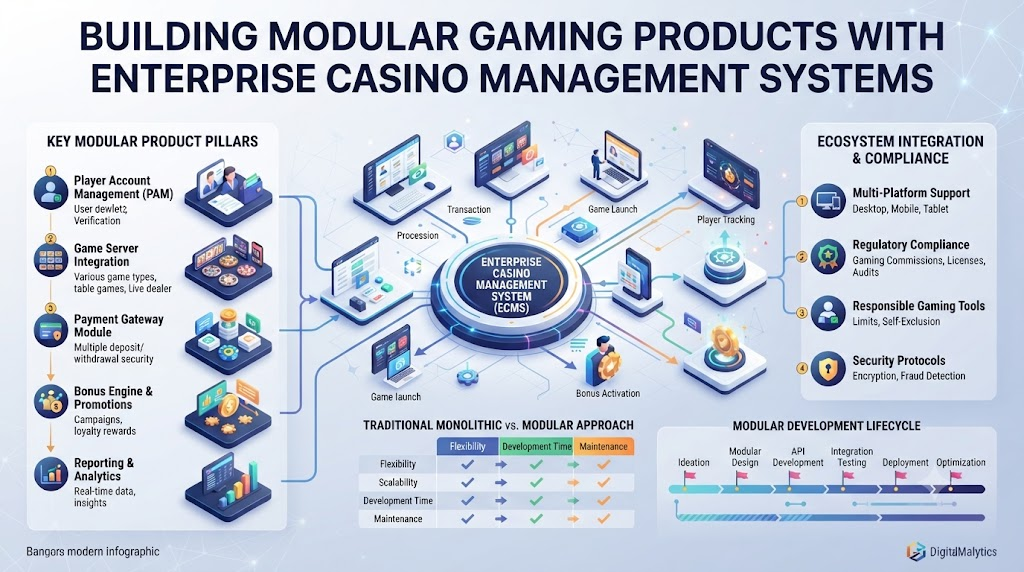
Digital product managers in the gaming sector face a continuous balancing act: delivering frictionless user onboarding, rolling out dynamic gamification features, managing multi-tier loyalty programs, and maintaining rock-solid platform stability. When product teams work with rigid, legacy back-office architectures, feature releases take months, user journeys become fragmented across disjointed interfaces, and roadmap agility slows down significantly. Deploying modern casino management systems provides product and engineering leaders with a robust foundation to power customer lifecycles, orchestrate real-time engagement mechanics, and decouple frontend user experiences from transactional backends. Understanding how these core platforms support feature innovation, coordinate third-party integrations, and interface with content systems allows product leaders to build adaptable, scalable digital products. This guide explores the platform capabilities, modular design patterns, player lifecycle architectures, and strategic evaluation frameworks that shape modern digital gaming products.
What Are Casino Management Systems?
From a product management perspective, a casino management system serves as the foundational transactional engine and user lifecycle platform of an iGaming enterprise.
In physical venues, this casino management software bridges land-based hardware, floor tracking, cashier desks, and physical loyalty kiosks into a single administrative record. In online environments, the platform acts as an enterprise-grade iGaming software platform responsible for core Player Account Management (PAM), wallet transactions, bonus engine execution, session routing, and regulatory telemetry.
Rather than handling presentation layouts or visual marketing campaigns, this system functions as the underlying product operating system. Technical product managers, feature owners, and digital strategists treat it as the mission-critical platform layer that governs user accounts, tracks lifecycle milestones, and exposes the foundational APIs needed to build intuitive, high-converting digital products.
How Casino Management Systems Work
From a product lifecycle and user journey perspective, the platform processes player state transitions systematically to maintain transaction accuracy while enabling real-time product features.
[ User Interaction ] ---> [ State & Rule Engine ] ---> [ Integration Bus ] ---> [ Real-Time Feature Delivery ]
 (Login / Bet / Cashier)    (Limits / Balance / KYC)     (Games / PSPs / CRM)     (Dynamic UI / Analytics)
- User Interaction Ingestion: A player registers, deposits, launches a title, or claims a promotion through the client interface, triggering secure requests to the platform.
- State and Business Rule Validation: The engine validates the incoming event against active account statuses, verification levels, available wallet balances, and localized jurisdiction constraints.
- Downstream Service Dispatch: The system coordinates with external providers—such as executing a payment gateway call or authenticating a game server session—via secure service bridges.
- Data Commitment and Event Broadcasting: All state changes and balance mutations are saved to transactional databases, while event notifications publish to real-time streams for downstream product analytics.
- Dynamic Experience Rendering: The frontend applications consume verified status updates to refresh user balances, trigger loyalty rewards, and update promotional states in real time.
Core Components of the Platform Architecture
A modern product platform organizes essential capabilities into modular subsystems that support independent feature development.
Player Account Management (PAM)
The PAM layer manages user profiles, registration workflows, authentication credentials, account verification milestones, and responsible gaming limits, serving as the central directory for customer journeys.
Transactional Core and Multi-Wallet Engine
This subsystem handles real-time ledger accounting, multi-currency processing, bonus partitioning, and balance updates across gaming sessions, ensuring atomic consistency for every wager and payout.
Game Gateway and Catalog Orchestration
The gateway integrates third-party Remote Game Servers (RGS) through standardized API interfaces, ensuring smooth session handshakes, fast load times, and synchronized game history across providers.
Engagement and Bonus Rule Engine
This engine enables product managers to build automated promotional workflows, including dynamic deposit matches, wagering trackers, loyalty tiers, and automated milestone rewards.
The Role of Casino CMS and iGaming Software
A core responsibility of digital product leadership is separating transactional backend logic from editorial content presentation tools.
| System Layer | Product Purpose | Primary Data Managed | Core Focus |
| Casino Management Systems | Transactional & Operational Engine | User accounts, balances, game outcomes, audit logs | Transaction integrity, user state, compliance |
| Casino CMS / iGaming CMS | Content & Experience Hub | Game catalogs, promotional copy, FAQs, metadata | Editorial speed, localization, discovery |
| Casino Website Software | Frontend Presentation Framework | UI templates, client-side routing, page layouts | User experience, load speed, responsive design |
The back-office core manages transactions and account state, while a specialized casino content management system empowers editorial and marketing teams to update game collections, publish promotional rules, and optimize landing pages independently. Decoupling the frontend casino website software ensures that content updates and design iterations proceed rapidly without impacting backend transactional stability.
Important Features to Evaluate
Product managers evaluating new casino platform software should focus on flexibility, integration ease, and user experience capabilities:
- Comprehensive API Ecosystem: Rich REST and WebSocket endpoints allowing engineering teams to build custom, headless user interfaces.
- Modular Rule and Bonus Engines: Visual configuration tools that let product teams design promotions and loyalty tiers without requiring custom backend code.
- Frictionless Onboarding Support: Modular verification flows that balance compliance checks with low drop-off registration steps.
- Real-Time Data Streaming: Event-driven architecture that pipes user telemetry into product analytics platforms for conversion tracking.
- Multi-Brand and Multi-Jurisdiction Support: Multi-tenant infrastructure that enables running distinct localized product skins on a single platform core.
- Granular Role-Based Permissions: Clear permission segregation that allows operational teams to manage support and finance without risking platform configuration errors.
Integrations and Technical Architecture
Product platforms rely on an interconnected ecosystem of specialized third-party services to deliver a complete gaming experience.
                              +------------------------------------+
                              |     Central Management Core        |
                              +-----------------+------------------+
                                                |
         +--------------------+-----------------+--------------------+--------------------+
         |                    |                                      |                    |
+--------v--------+  +--------v--------+                    +--------v--------+  +--------v--------+
| Payment Desks   |  | Game Gateways   |                    | Marketing / CRM |  | Headless CMS    |
| (Multi-PSP Hub) |  | (RGS Connectors)|                    | (Personalization|  | (Content/Media) |
+-----------------+  +-----------------+                    +-----------------+  +-----------------+
- Payment Gateways (PSPs): API connectors handle local and international payment methods, providing instant deposit confirmations and automated withdrawal workflows.
- Remote Game Servers (RGS): Standardized aggregation interfaces allow rapid onboarding of new game studios without custom code per vendor.
- Marketing and CRM Integrations: Real-time event streams trigger automated player messaging, milestone celebrations, and lifecycle retention campaigns.
- Headless Content Systems: Structured APIs feed game metadata, promotional assets, and editorial guides from the casino CMS directly to client applications.
Security, Compliance, and Responsible Technology
Building a sustainable digital product requires integrating safety, data privacy, and compliance directly into the player experience:
- Secure Authentication: Multi-factor authentication (MFA) options, biometric login capabilities, and automated session management to safeguard user accounts.
- Data Protection by Design: Enforcing end-to-end encryption (TLS 1.3 in transit, AES-256 at rest) and strict data segregation to protect personal user records.
- User-Centric Responsible Gaming Tools: Clear, accessible self-service controls allowing users to set deposit limits, session timers, and cooling-off periods directly from their profile menu.
- Automated Account Governance: Policy engines that identify suspicious patterns and enforce statutory exclusions instantly across all connected product interfaces.
Compliance standards vary by operating region. Modern platforms allow product teams to localize compliance parameters—such as verification triggers and statutory messaging—within configuration menus rather than hardcoding requirements into product builds.
Benefits and Limitations
Adopting enterprise-grade management platforms involves clear product and operational trade-offs.
Benefits
- Accelerated Time-to-Market: Pre-built PAM, wallet, and game gateway modules eliminate the need to build complex transactional infrastructure from scratch.
- Enhanced Product Agility: Decoupled frontends allow product teams to test new user experiences and UI flows without backend redeployments.
- Scalable Infrastructure: Robust database architectures support rapid traffic spikes during sporting tournaments or product launches.
Limitations
- Integration Complexity: Orchestrating third-party services, webhooks, and payment rails requires thorough testing and ongoing API maintenance.
- Configuration Overhead: Managing complex bonus rules, localized limits, and user permissions across multiple markets requires continuous product oversight.
- Platform Dependencies: Proprietary data formats can create vendor lock-in, making future platform migrations resource-intensive.
Common Mistakes During Selection and Implementation
- Over-Coupling Frontend and Backend: Building UI components directly into the management backend instead of maintaining a decoupled, headless architecture.
- Ignoring User Onboarding Friction: Implementing rigid verification steps that cause high drop-off rates during initial registration.
- Underestimating API Capabilities: Selecting software with limited or poorly documented endpoints, restricting custom feature development.
- Treating Content and Transactional Data as Identical: Trying to manage editorial game reviews and marketing copy within transactional player databases.
- Overlooking Real-Time Analytics: Choosing platforms that rely on daily batch exports rather than real-time event streaming for product telemetry.
- Failing to Account for Multi-Market Scaling: Selecting single-market solutions that require complete redeployment to enter new regulated regions.
Real-World Use Cases
- Headless Multi-Brand Portfolio: A product team launches three localized gaming brands with distinct visual identities, all powered by a single core platform and managed via a headless iGaming CMS.
- Automated Lifecycle Loyalty Engine: Event triggers within the management platform automatically credit promotional perks to players as they reach specific engagement milestones.
- Unified Cross-Platform Wallet: Delivering a seamless balance experience across mobile apps, desktop web browsers, and retail kiosks via centralized API endpoints.
- Dynamic Game Categorization: Connecting real-time game round data to frontend search and filtering systems to surface trending titles dynamically.
Evaluation Framework
| Product Dimension | Key Criteria | Strategic Value |
| Architectural Agility | Headless API support, microservices structure | Enables rapid frontend UI iterations and custom feature development. |
| Player Experience | Unified wallet, self-service limits, fast load times | Enhances conversion rates, retention, and player satisfaction. |
| Promotional Flexibility | Configurable bonus engines, multi-tiered loyalty | Supports dynamic marketing campaigns without engineering intervention. |
| Data Accessibility | Event-driven webhooks, data lake connectors | Empowers data-driven product optimization and conversion tracking. |
| Scalability & Uptime | High-throughput concurrency, horizontal scaling | Guarantees platform availability during peak marketing campaigns. |
Step-by-Step Selection and Implementation Guide
- Define Core Product Requirements: Document target player journeys, expected transaction volumes, supported payment methods, and target licensing regions.
- Evaluate API and Integration Surfaces: Test candidate platform APIs for speed, documentation completeness, and support for headless presentation architectures.
- Assess Engagement and Promotional Engines: Confirm that product teams can configure bonuses, loyalty programs, and promotional campaigns without writing code.
- Review Security and Responsible Gaming Baselines: Verify that the platform supports user self-service limits, encrypted data storage, and strict access controls.
- Build Decoupled Frontend Prototypes: Develop proof-of-concept user interfaces connecting to platform sandbox APIs to validate integration ergonomics.
- Execute Staged Data and User Migration: Migrate customer profiles, balances, and historical records in test environments, verifying ledger accuracy.
- Deploy Real-Time Telemetry and Launch: Instrument user journey tracking across frontend and backend systems before opening access to production traffic.
Future Trends in Management Technology
- Composable Headless Ecosystems: Complete adoption of microservices architectures where PAM, content CMS, search, and bonus engines function as independent services.
- Real-Time Personalization Engines: Machine learning services consuming event streams to deliver customized game recommendations and dynamic UI layouts.
- Automated Player Protection Models: Intelligent monitoring that identifies early signs of burnout or problematic play, triggering supportive interventions automatically.
- Cross-Platform Digital Identities: Universal, portable identity verification frameworks that streamline onboarding across multiple digital properties.
Frequently Asked Questions
1. What strategic value do casino management systems provide to product teams?
They supply the core transactional backbone—handling player identities, wallets, game sessions, and compliance rules—allowing product teams to focus on user experience and frontend innovation.
2. How does an operational management platform differ from a casino CMS?
An operational management platform handles backend transactional ledgers, user accounts, and compliance logs, while a casino CMS is used to manage game reviews, landing pages, and marketing content.
3. Why is a headless architecture advantageous for gaming platforms?
A headless architecture decouples the frontend user interface from the backend management engine, enabling faster UI updates, better mobile performance, and independent development cycles.
4. How do modern platforms support player engagement and retention?
They feature flexible rule engines that automate promotional bonuses, milestone rewards, and loyalty tracking based on real-time player activity.
5. What is Player Account Management (PAM) in product design?
PAM is the central module managing user identity, profile details, authentication, verification milestones, and responsible gaming limits.
6. How do management systems connect to diverse game studios?
They use standardized API gateways that aggregate Remote Game Servers (RGS), allowing operators to add new titles without custom integration development for each provider.
7. How do these platforms balance onboarding speed with regulatory compliance?
They integrate automated verification pipelines that verify standard player data instantly while queuing complex profiles for manual review, reducing registration drop-off.
8. What role do APIs play in modern gaming product stacks?
APIs allow the transactional core to communicate seamlessly with front-end presentation software, payment providers, analytics tools, and CRM engines.
9. How do casino management systems enforce responsible gaming?
They provide self-service controls for players to establish deposit, loss, and time limits, which the platform enforces automatically across all connected gaming sessions.
10. What is the primary product challenge during a platform migration?
Ensuring zero disruption to user account access, maintaining continuous balance accuracy, and preserving historical loyalty milestones during the data transfer.
Conclusion
Modern casino management systems serve as the vital infrastructure that enables product teams to deliver engaging, scalable, and secure gaming products. By separating the foundational transactional engine from front-end presentation systems and marketing CMS platforms, organizations gain the architectural freedom to iterate on player journeys rapidly. Selecting a platform with strong API capabilities, flexible rule engines, robust security controls, and decoupled content pipelines ensures that digital product teams can scale their offerings effectively while maintaining compliance and operational reliability.
Leave a Reply