Detailed FinOps Foundation Certification Overview: Skills, Framework, and Career Paths
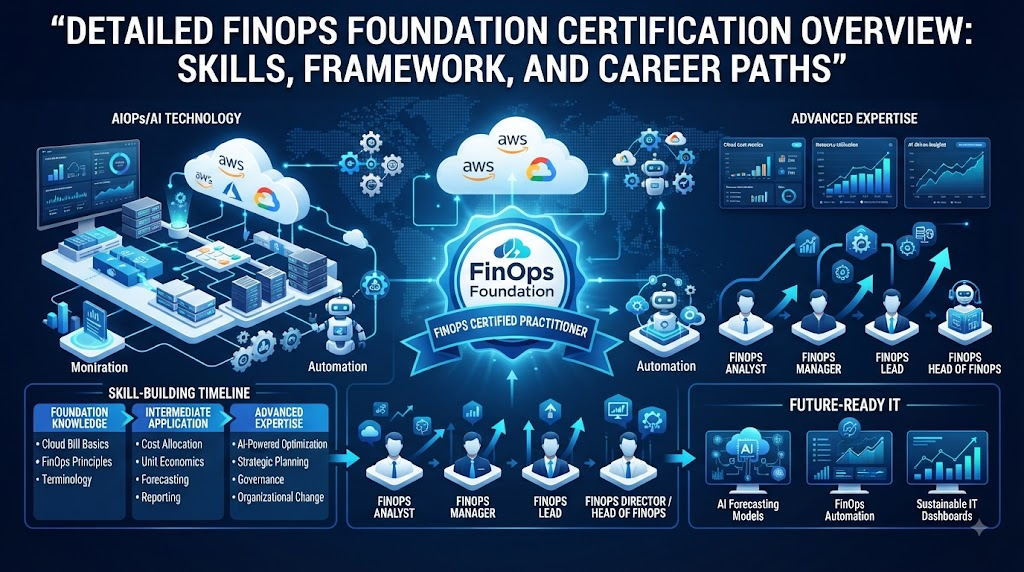
Cloud computing makes it possible to provision infrastructure, platforms, data services, and software quickly. However, that flexibility can also make technology spending difficult to understand, predict, and optimize. The FinOps Foundation Certification is designed for professionals who want to understand how organizations manage cloud and broader technology spending while improving business value. FinOps combines financial accountability, engineering collaboration, cloud cost visibility, and business decision-making. It is not simply about reducing a cloud bill. Instead, it helps organizations make informed trade-offs among cost, speed, quality, innovation, and operational requirements. This guide explains FinOps, the FinOps Foundation, certification options, the FinOps Framework, essential skills, preparation approaches, practical projects, career paths, and common mistakes to avoid.
What Is FinOps Foundation Certification?
FinOps Foundation Certification refers to the certification and training programs offered by the FinOps Foundation, an organization focused on advancing technology value management practices. Its catalog includes credentials such as FinOps Certified Practitioner, FinOps Certified Professional, FinOps Certified Engineer, FinOps Certified FOCUS Analyst, and FinOps Certified AI Value.
For many learners, the FinOps Certified Practitioner credential is a natural starting point because it focuses on the fundamentals of FinOps. The purpose is to help professionals understand how cloud and technology costs can be managed through cross-functional collaboration rather than treating cost as a finance-only responsibility.
A FinOps certification can support professional development by helping learners build a common language around cloud spending, cost allocation, forecasting, optimization, budgeting, and business value. It does not guarantee employment, a promotion, or a salary increase, but it can demonstrate structured knowledge in a growing area of cloud operations.
What Is FinOps?
FinOps is a collaborative operating model and cultural practice for managing the value of cloud and technology spending. It brings together people from engineering, finance, product, procurement, leadership, and other business functions.
In simple terms, FinOps helps an organization answer questions such as:
- What are we spending on cloud services?
- Which team, product, customer, or environment is driving the cost?
- Is that spending producing meaningful business value?
- Where is cloud waste occurring?
- Which technical or commercial changes could improve efficiency?
Cloud costs are dynamic because organizations can launch, scale, modify, or stop resources quickly. A development team might create new compute instances, data services, storage capacity, or AI workloads in minutes. Without visibility and accountability, costs can rise before finance teams even understand why.
FinOps creates a shared responsibility model. Engineers retain ownership of technical choices, finance teams help with planning and financial governance, and leadership connects technology investment to strategic outcomes.
Why FinOps Matters
FinOps matters because cloud spending is often variable, distributed, and tied directly to product decisions. Traditional annual budgeting models may not be enough when infrastructure usage changes daily.
Organizations adopt FinOps to improve:
- Cloud cost visibility: Teams can see spending by account, application, project, environment, team, product, or cost center.
- Cost control: Teams can identify unused resources, idle environments, oversized workloads, and inefficient architectures.
- Budget management: Finance and technical teams can monitor actual spending against planned budgets.
- Forecasting: Organizations can estimate future spend using usage trends, planned launches, commitments, and business growth assumptions.
- Resource optimization: Engineers can rightsize services, adopt autoscaling, choose better architectures, and remove waste.
- Financial accountability: Teams understand the cost impact of their technology choices.
- Business value: Leaders can evaluate whether spending supports customer growth, product performance, innovation, or other meaningful outcomes.
For example, a company may discover that a non-production environment is running high-cost infrastructure every night and weekend. Rather than applying broad cost cuts, a FinOps team can work with engineering to schedule that environment, preserve developer productivity, and reduce unnecessary consumption.
About the FinOps Foundation
The FinOps Foundation is a project of the Linux Foundation dedicated to advancing people who manage technology value through best practices, education, and standards. The Foundation reports a community of more than 120,000 people across over 34,000 companies, including 97 of the Fortune 100.
Its role in the FinOps ecosystem includes:
- Publishing and evolving the FinOps Framework
- Providing training and certification programs
- Supporting a global practitioner community
- Creating educational resources and community events
- Encouraging common data standards, including FOCUS
FOCUS, or the FinOps Open Cost and Usage Specification, is an open specification intended to reduce complexity in technology cost and usage billing data. It helps improve consistency for practitioners working across providers and technology categories.
Certification Structure and Learning Paths
The FinOps Foundation training catalog currently lists several learning options across fundamentals, intermediate, and advanced levels. These include FinOps Certified Practitioner, FinOps Certified Professional, FinOps Certified Engineer, FinOps Certified FOCUS Analyst, FinOps Certified AI Value, Introduction to FOCUS, and FinOps Trained Containers.
The right option depends on your role and goals:
| Certification / Learning Path | Main Focus | Best For | Key Skills |
|---|---|---|---|
| FinOps Certified Practitioner | FinOps fundamentals | New and aspiring FinOps practitioners | Cost visibility, collaboration, optimization concepts |
| FinOps Certified Professional | Advanced FinOps practice | Experienced FinOps professionals | Practice leadership, advanced application |
| FinOps Certified Engineer | Engineering-oriented FinOps | Cloud and platform engineers | Technical cost optimization and engineering accountability |
| FinOps Certified FOCUS Analyst | Cost and usage data standardization | Analysts and data-focused practitioners | Billing data normalization and analysis |
| Cloud certifications | Provider-specific cloud services | Cloud engineers and architects | Cloud architecture, operations, security |
| DevOps certifications | Delivery and operations practices | DevOps and SRE professionals | Automation, CI/CD, reliability, operations |
The official learning catalog offers self-paced, instructor-led, and exam-only options for the FinOps Certified Practitioner path. The catalog states that the exam-only option includes three attempts over one year, while course bundles may include 12 months of course access and an exam. Verify current availability, pricing, and assessment details directly with the Foundation before enrolling because offerings can change.
Who Should Pursue FinOps Certification?
FinOps Foundation Certification can be relevant to professionals who influence cloud usage, technology budgets, reporting, or investment decisions.
Potential learners include:
- FinOps practitioners and FinOps analysts
- Cloud engineers and cloud architects
- DevOps engineers and SRE professionals
- Platform engineers
- Cloud consultants
- Finance and procurement professionals supporting technology spending
- IT managers and engineering managers
- Product leaders and technology leaders
Suitability depends on your existing knowledge and career goals. A finance professional may focus on cost allocation, reporting, chargeback, forecasting, and budget governance. An engineer may focus on workload rightsizing, architecture choices, resource scheduling, tagging, commitments, and automation.
Eligibility, Prerequisites, and Skills
Formal prerequisites can vary by specific course or certification. Do not assume a degree, a particular cloud certification, or a fixed number of years of experience is required unless the official program explicitly states it.
However, the following knowledge is generally helpful:
- Basic cloud computing concepts such as compute, storage, networking, managed services, and consumption pricing
- Familiarity with at least one major cloud platform
- Awareness of billing, budgets, invoices, cost centers, or financial planning
- Basic spreadsheet, dashboard, and data-analysis ability
- Interest in cross-functional communication between technical and business teams
A learner can gain skills in cloud cost management, allocation, reporting, anomaly detection, budget tracking, forecasting, optimization, cloud economics, and financial accountability. Just as importantly, FinOps develops the ability to explain cloud spending in terms that engineering, finance, and leadership can use.
FinOps Framework and Principles
The FinOps Framework provides common building blocks for a FinOps practice. It includes principles, personas, maturity characteristics, measures of success, and functional activities. The Framework is intentionally flexible rather than prescriptive, allowing organizations to begin with their most urgent needs and mature over time.
The current Framework organizes FinOps work around four outcome-oriented domains:
| FinOps Domain | Examples of Related Capabilities |
|---|---|
| Understand Usage & Cost | Data ingestion, allocation, reporting and analytics, anomaly management |
| Quantify Business Value | Planning, forecasting, budgeting, KPIs, benchmarking, unit economics |
| Optimize Usage & Cost | Architecting, workload placement, usage optimization, rate optimization, sustainability |
| Manage the FinOps Practice | Governance, policy and risk, education, automation, invoicing, chargeback |
These domains connect cloud cost data with operational and business decisions.
The Foundation highlights six major FinOps principles:
- Teams need to collaborate.
- Business value drives technology decisions.
- Everyone takes ownership for their technology usage.
- FinOps data should be accessible, timely, and accurate.
- FinOps should be enabled centrally
- Organizations should take advantage of the variable cost model of cloud and other technology categories.
In practice, this means cost optimization should not be an isolated monthly cleanup. Engineers should consider cost during design, finance should receive timely data for planning, and leadership should evaluate technology spend using meaningful business metrics.
FinOps Lifecycle Explained
The FinOps Framework describes an iterative journey with three phases: Inform, Optimize, and Operate.
- Inform: Create reliable visibility into usage and cost. This includes collecting billing data, applying allocation methods, improving tags or labels, producing reports, and identifying anomalies.
- Optimize: Identify and prioritize opportunities to improve value. Examples include rightsizing compute, deleting unused storage, scheduling non-production workloads, improving commitment usage, and choosing cost-aware architecture patterns.
- Operate: Establish the processes, governance, automation, and accountability needed to sustain FinOps. Teams review KPIs, manage budgets, monitor forecasts, improve policies, and embed cost awareness into normal operations.
The cycle repeats. Insights from operating activities improve future data quality, optimization priorities, and financial planning.
Tools, Use Cases, and Projects
FinOps technology commonly includes cloud-provider billing portals, cost-management dashboards, data warehouses, reporting tools, budget alerts, tagging systems, optimization platforms, and governance automation. Major cloud providers offer native tools for billing analysis, budgets, alerts, recommendations, and cost reporting, but the right toolset depends on an organization’s cloud footprint, reporting needs, and data maturity.
Common FinOps use cases include:
- Allocating cloud costs to teams, products, customers, or environments
- Detecting unusual spending spikes before month-end
- Forecasting cloud spend for a product launch
- Rightsizing underutilized virtual machines or managed services
- Improving multi-cloud cost reporting
- Connecting cloud spend to unit metrics, such as cost per customer transaction
Useful hands-on projects for learners include:
- Build a cloud cost dashboard organized by team and environment.
- Create a monthly cloud spending report with variance analysis.
- Design a tagging or allocation model for shared services.
- Build a budget-versus-actual tracker.
- Analyze unused resources and recommend optimization actions.
- Produce a simple forecast using historical cost and growth assumptions.
Preparation Roadmap and Mistakes
A practical FinOps certification preparation roadmap is:
- Learn cloud pricing and core consumption concepts.
- Study FinOps fundamentals and the official FinOps Framework.
- Understand the Inform, Optimize, and Operate lifecycle.
- Learn common allocation, reporting, budgeting, forecasting, and optimization concepts.
- Review official training materials for your selected credential.
- Practice with realistic spending and accountability scenarios.
- Complete one or two hands-on projects using cloud billing data or sample datasets.
- Identify weak areas and revisit the relevant official resources.
- Confirm the current exam and enrollment requirements before scheduling an assessment.
Avoid these common mistakes:
- Memorizing terminology without understanding business context
- Treating FinOps as only a cost-cutting function
- Ignoring allocation and data quality
- Focusing only on infrastructure while ignoring business value
- Skipping hands-on analysis and reporting practice
- Assuming finance or engineering can run FinOps alone
- Using outdated exam details instead of reviewing official sources
Career Opportunities and Growth
FinOps knowledge can support roles such as FinOps Practitioner, FinOps Analyst, FinOps Engineer, Cloud Cost Analyst, Cloud Financial Management Professional, Cloud Architect, Platform Engineer, and Cloud Consultant.
Responsibilities vary by organization, but may include billing-data analysis, allocation design, budget support, forecast development, optimization reporting, stakeholder communication, commitment planning, and governance automation.
Salary and career growth depend on experience, location, cloud expertise, industry, organization size, technical depth, data skills, and the scope of responsibility. Certification may help validate foundational knowledge, but practical cloud experience, communication skills, and demonstrated business impact remain important.
Future of FinOps
FinOps is expanding beyond traditional public-cloud billing. The current Framework includes technology categories such as cloud, SaaS, licensing, data platforms, and data centers, reflecting a broader technology value-management focus.
Important trends include AI-assisted optimization, automation, multi-cloud reporting, unit economics, sustainability-aware decision-making, and closer integration with platform engineering. As technology consumption becomes more variable, organizations will need timely data and shared accountability to make effective decisions.
FAQs
What is FinOps Foundation Certification?
FinOps Foundation Certification refers to credentials and training programs offered by the FinOps Foundation for professionals learning cloud and technology financial management practices.
What does FinOps mean in cloud computing?
FinOps is a collaborative practice that helps teams manage cloud spending, usage, optimization, forecasting, and business value.
Who should take FinOps Foundation Certification?
It can suit FinOps practitioners, cloud engineers, DevOps professionals, architects, finance professionals, IT managers, and technology leaders.
Is cloud experience required for FinOps certification?
Requirements depend on the specific program. Basic cloud knowledge is highly useful, even when formal prerequisites are not stated.
What skills can I learn from FinOps training?
You can learn cost visibility, allocation, reporting, budgeting, forecasting, optimization, cloud economics, and cross-functional collaboration.
What is the FinOps lifecycle?
The recognized FinOps lifecycle consists of Inform, Optimize, and Operate phases.
How does FinOps help reduce cloud costs?
FinOps helps identify waste, improve resource usage, apply allocation, optimize rates, and support informed architecture and purchasing decisions.
Is FinOps only for finance teams?
No. FinOps relies on collaboration among engineering, finance, product, procurement, leadership, and other relevant teams.
What is cloud cost allocation?
Cloud cost allocation is the process of assigning spending to the appropriate team, product, customer, environment, project, or cost center.
How should I prepare for a FinOps assessment?
Study official materials, understand the Framework and lifecycle, practice realistic cost-management scenarios, and confirm current requirements through official sources.
Does FinOps certification guarantee a job?
No. It can support professional development, but hiring decisions also depend on experience, technical skills, communication ability, and organizational needs.
What is FOCUS in FinOps?
FOCUS is the FinOps Open Cost and Usage Specification, an open specification intended to make technology cost and usage data more consistent and easier to work with.
Conclusion
FinOps Foundation Certification can be a useful learning step for professionals who want to understand cloud financial management, cost optimization, forecasting, allocation, and technology value. FinOps is not solely about lowering cloud spend; it is about enabling better decisions through reliable data, shared accountability, and alignment with business outcomes. Whether you work in cloud engineering, DevOps, finance, architecture, consulting, or leadership, practical FinOps knowledge can help you participate more effectively in cloud-cost and technology-value decisions. Start with the fundamentals, use the FinOps Framework as a guide, work with realistic cost data, and continue building hands-on experience as your responsibilities grow.
Leave a Reply